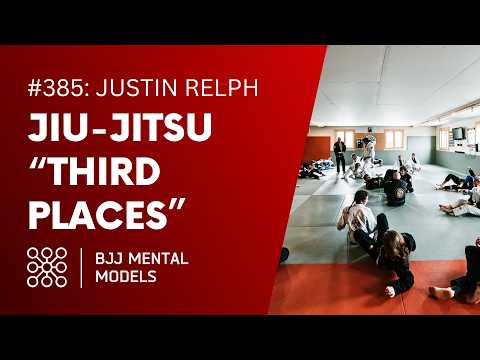
This week, we're joined by Justin Relph! Justin is a self-described die-hard hobbyist, event marketer, and the black belt coach behind Jiu Jitsu Invermere, a not-for-profit gym in the mountains of British Columbia. In this episode, Justin shares his experience building community through jiu-jitsu in a small resort town, and we revisit the concept of third places: the social spaces beyond home and work that so many of us are missing. Topics include: the decline of third places in modern life, how to build gym culture around community rather than competition, bringing jiu-jitsu to where people are, and the power of unstructured social time after training.
The world's LARGEST library of jiu-jitsu audio lessons, our complete podcast network, online coaching, and much more! Your first week is free: https://bjjmentalmodels.com
MINDSET FOR BETAS, our new Jiu-Jitsu audio course with Rob Biernacki, is now available on BJJ Mental Models Premium! For a limited time, get your first month FREE at: https://bjjmentalmodels.com/beta
Transcript
Show transcript
Speaker 1: Hey everybody, before we get started this week, I just want to let you know we released a new mindset course featuring Rob Bernaki from Island Top Team and BJJ Concepts. It's called Mindset for Betas. It's an amazing resource that breaks down a new way to build a resilient Jiu-Jitsu mindset. It's part of BJJ Mental Models Premium. I will spare you the full sales pitch because you can try it for free. Just go to BJJmentalmodels.com/beta. I will give you a free month, you can check out the course and if you decide that it's not worth your money, you can cancel, you won't have to pay a cent. I've already been told by subscribers that this is the most valuable piece of Jiu-Jitsu content they've ever received, so I hope you like it too.
Speaker 1: Hey everybody, welcome to BJJ Mental Models episode 385. I am Steve Kwan and BJJ Mental Models is your guide to a conceptual and intelligent Jiu-Jitsu approach. And we're talking about third places here today. I've got Justin Ralph on the line from Jiu-Jitsu Invermere, a fellow British Columbian. Justin, how's it going?
Speaker 2: Yeah, really good, Steve. How are you doing?
Speaker 1: I am good, man. Now, you have been in our community since forever. A long, long time.
Speaker 2: I think so.
Speaker 1: Yeah, you've been a member of the BJJ Mental Models community, but first time on the podcast, so give yourself an intro here.
Speaker 2: Yeah, yeah. Thanks for having me for sure and giving me the opportunity to to talk about this subject. It's kind of close to my heart as a, I guess I'll call myself die hard hobbyist. I came to the sport kind of, I'm going to describe it as like after my competitive athletic career, I actually discovered Jiu-Jitsu because I was looking for something not competitive to do, which is kind of a ridiculous statement, but that's how it happened. I had lived in a ski town in Whistler for a long time. I had moved to Victoria and I'd started playing rugby, which was the sport I played when I was younger and realized I would still have to play with the young bucks and I was working for the university and pretty close to them and they were all national team members and I was like, no, I'm just trying to meet people and play sport that I think is fun that I had a run in. So I decided to stop doing that. Of course, love being around a rugby club and uh still still did that socially, but just was looking for something new to do and so found Jiu-Jitsu and then uh it slowly took over my life. And then uh I've moved to the interior to a small town and without sort of meaning to, I've really ended up running a gym and being a coach.
Speaker 1: So this is a great chance to talk about community building, which I really think is kind of one of the most promising areas of growth in the sport of Jiu-Jitsu. Now, I know that in addition to this, you also do a lot of event management. I know that you've set up like hybrid Jiu-Jitsu nature camps in the Invermere area, which I think is another great way that we can bring people into the sport and encourage that sense of community. But there's a concept in sociology called third places. And I know we've talked about this on the podcast before, but it has been a while. The idea is that you need to have at least three places that define your life. There is your home, there is your place of work, and then there is a third place. And that's the place for community, that's the place for socializing, that's the place for relaxing and letting off steam. And everyone needs to have one of these. And if you go back in time, you know, 50 years, probably most people had a third place that you could point to where it was some sort of club or recurring social event or even like a coffee shop or a bar or a church or a hobby. There were a lot of places that you could make into your third place. And it feels like that's getting harder and harder to find in modern life for a variety of reasons that I'm sure we'll get into here. I'd love to hear you talk about this idea of a third place and your experience with this, both in life and in in and out of the sport of Jiu-Jitsu as well.
Speaker 2: Yeah, yeah, for sure. And I think you're right. I think it's become a sort of a topic people are thinking about more because of the overtime, the erosion of that sort of natural ability to have these third places. You know, and I think COVID definitely showed us how important it was to have somewhere other than work and your family to be, right? And then, you know, with how many digital spaces there are and how strong social media is, especially for kids. I mean, I feel I'm that generation where I sort of grew up without a phone, you know, and without the internet, and it was sort of around university when it happened. So I've so I've lived through both and I feel feel lucky for that. I just can't couldn't imagine being a teenager right now and just how dominant digital spaces are and not being connected physically. So those are the big ones. But I also had lots of experiences with like adventure sports. So skiing, climbing, surfing, those sort of things. And they always, it always struck me that they were kind of a bit of a special thing. They were sort of a hybrid of not like a traditional sport and what I was used to about competing for a spot on the team and and and those sort of things. It was sort of there was like a much stronger social aspect to them. I think climbing and climbing gyms were the first place I really noticed that really strongly and just like how enriching, you know, that was. You get the same thing on the beach, you know, at the at a surf break, maybe not in the surf because you are competing for waves, so that's a different dynamic sometimes. But uh, you know, skiing as well, you know, you sort of naturally fall into these groups that are sort of interpreting that sport in the way that they want and just how you kind of support each other and you get this other social group other than your normal friends, other than what you're doing at work.
Speaker 1: Yeah. I think the challenge of the modern day is a lot of these places that used to be such a huge defining part of our life have started to collapse together a bit. I mean, with the rise of remote work, which is amazing, right? It's opened up a ton of possibilities that didn't exist before. Probably it's better for the planet, it cuts down on commute time. Remote work has a ton of advantages, but the downside to this is it collapses your first and second places, your home and your work into the same place. And so now you even have less variety in your life. And with the kind of decline of third places as well, you can really easily get to a point in your life where you're doing a lot, but you're not actually going anywhere or leaving your bubble very often. And that's one of the downsides to this incredible technology that we have and you know, you talked about the internet, right? You and I were probably part of the last generation that will remember what it was like to not have the internet, but then also to grow up and start using it and see this incredible technology flourish and grow and become just a total requirement for daily life. I mean, at this point, the idea of not having the internet, it's it's basically a public utility at this point. I don't know how you could actually live in society if you didn't have the internet. And that comes with its own problems. Authenticity is one of them. I mean, as of this recording, I just saw in the news, Dig shut down again. I don't know if you remember Dig, but it was like the precursor to Reddit many, many, many, many years ago. They were trying to reboot it and it only lasted for a few weeks and then they promptly killed it off again. And they said part of the problem they had was just too many bots, too much fake stuff, not enough real human engagement. So when you're in these modern third places online, I mean, a lot of them, you don't even know if they're actually real, right? You could be talking to GPT for all you know. So I think it's kind of dangerous to make that a substitute for a real third place. And again, one of the things that Jiu-Jitsu has is the ability to act as that third place, which I think is one of the coolest things about the sport.
Speaker 2: Yeah, yeah, absolutely, absolutely. And um, you know, it made me think, you know, we just sort of both talked about how we, you know, how strongly a Jiu-Jitsu experience can map onto a third place, but I think there are some considerations about how you can sort of start steering away from it. And I don't mean that to say it's better or worse, but just, you know, the audience and even ourselves like aren't 100% clear that there are some different structures that can happen and it does depend on how you, what culture you have at your gym, what your goals are for a gym to be able to say, hey, this is very much a third space and we're doing all those things that we want or if it's something a little bit else, something say closer to a workspace. And if it's okay, I wouldn't wouldn't mind talking about that for a few minutes.
Speaker 1: Please do.
Speaker 2: So I think the best one, so, you know, we just went through it, right? And then I think that experience we just talked about really maps onto that sort of beginner's experience or hobbyist's experience, right? When it's really just sort of learning the ropes, immersing yourself in this new skill with these other people are sort of also doing that, right? And that's perfect, right? That works out really well. But as we sort of ramp up the sport side of it to be a more say competitive gym, right? Then those structures start changing a little bit, right? The you're going to be more focused on strong performances, right? About just winning and being a little bit less open to failing and error and exploration, right? The more you're doing competitive matches, right? And you're going to have a a stronger pecking order structurally of who's the best and who isn't, right? And that starts coming away from being what we're talking about is a third space. I don't mean to say this is bad at all. It's great, but it's a different thing, you know? So I say that to just maybe give pause to someone who who's like, yeah, I'm a third space, but also running a really competitive program to say, oh, maybe there's some features here we need to change a little bit if we really want it to be a third space as well. Or say, hey, you know what? That's actually not us, right? We're here to do competitive team sport and that's what we're doing. You know, and then you take that another rung farther and you're a professional gym, which I'll say, there's a place for and there's not too many of them and there probably shouldn't be too many of them because there's just not that many professional athletes. And I think they're a very different thing, right? Then it is we'll I'll just sort of TLDR it and say, then you're just a workplace, right? Then you're very much in that second space, right? They're not your family, right? They're not your not workspace. This is your workspace, right? And uh those expectations and how you act and all that sort of thing is different, which is fine. And if you get to that level, that's great. I think the problem is that we all sort of equate value with performance, with being professional, okay? And that's like not quite right. We can't all try to be the professional competitive gym, nor really do I think we should be, you know? Do I think that like every gym should have a part of their program that's really competitive? Sure, absolutely. But I think we maybe should be focusing on more broadly that 90% of people who never compete, who are just learning and their experience and fostering that culture and then having those other two things being a little bit different. Does that track? Does that make sense?
Speaker 1: Absolutely, and I love the way that you explained that when you look at competitive gyms, I mean, there's nothing wrong with that, like you said. And those can be a third place for the people who train there, but the collective of people that you'll be able to get to train there is much smaller and it's much less diverse. I mean, if you are running a competitive gym, just by virtue of the fact that it's a competitive gym, you're probably not going to get many people over 30 into the gym. Whereas I think the magic of Jiu-Jitsu really unlocks as a life pursuit. And that's where the hobbyist and the casual gyms really find their footing and add a lot of value back to society. So again, nothing against the competitive gyms, but when we talk about third places, their ability to impact the community at large is kind of restricted to maybe young athletes who take this super seriously, and they will eventually age out of it, right? I mean, you see this in wrestling where maybe your wrestling club is your third place up until you're 20s or your mid-20s. But once you age out of that, there really isn't a place for you anymore. You've kind of been evicted from your third place. You've you've aged out of it. Whereas Jiu-Jitsu doesn't have that ceiling. You can keep staying involved in the sport in some capacity pretty much forever, which is one of the things that I love about it, right? I mean, you've got super young, promising prodigy athletes in the sport, all the way up to like the, you know, the old coral belts who are still super active and still adding value into the community, even though they walk with a cane, right? And they're not in their physical prime anymore. There is still a place for those people in our sport. And that's one of the things to me that makes for a really awesome third place, is its ability to bring everyone in the door. And then you can start to meet and network with those people who wouldn't normally fall into the same demo as you.
Speaker 2: Yeah, it reminds me a little bit, maybe I'm I'm thinking of this sort of retroactively. I just sort of realized it now, but like my first, you know, my main sport was rugby, right? I had a father who was sort of national team level for for England, played for Canada. So I was just immersed from it from when I was a kid. And then of course, you know, when that's your dad, you're sort of like, okay, well, I guess that's what I'm going to do and uh want to aspire to that level. But I just really fell in love with that sport and a lot of what we're talking about happens there, right? You think of the structure of uh like the clubhouse in rugby and especially if you're in in Europe, less so in North America, but certainly in Toronto where I grew up, they had a place called Fletcher's Fields and it was like the home for many different teams. And on the weekend, everyone would play there, right? So if you thought of a hockey rink, you could think of the like a rink with like 10 different ice surfaces, right? And it's the home home rink for everyone. And just by sort of the nature of it, just being sort of grass and the clubhouse and pretty easily accessible, you know, there was old guys and 20-year-olds watching and helping out with like the little kids who are just playing touch, you know, and then those kids are watching the older kids play and the adults play. And then the people who are past their competitive prime or just want to take it easy, can play for the old guys. And then everyone who like whether they play or not is all in the clubhouse and they're in, you know, basically a a pub, you know, mixing and mingling, watching the games, encouraging each other, including the opposite teams. And um, that was just like the best, you know, I just found that so so amazing that culture and that's sort of something that I always want to try to recreate if I can. So, you know, so I went to Europe and and played rugby for a little bit there between high school and university. And it's even stronger there, right? Like when you finish a game there, it's like communal shower and bath, right? So everybody's like in this giant bathtub and it's the guys you were just trying to knock their heads off, right? Or they were knocking your head off or they just like trampled on you with their cleats and then you're in this big bubble bath together and it's just so uh like unique and way to way to bond and then, you know, someone's coming from the pubs and pints of Guinness for for everyone and then you get up there and the whole community's around and it's just uh such a mingler, you know, it's so so amazing and that's the kind of thing I want to recreate in our space.
Speaker 1: Well, that's leading me to think about one of the challenges with modern life, which is we have so many filters, so many ways to shut people off. If someone online is bothering you, you can just block them. If someone in your social life is being problematic, you can just adjust and work around them. And it used to be harder to do that. If there was someone in your social circle that was kind of problematic, well, you might have to sort of deal with that person. Now it's easy to just get rid of them. And although that's a great convenience, it also leads us to filter our lives down to the people who make our lives easy, and I don't think that's always a good thing. When you're on the internet, this is necessary. There's so many terrible people on there and bots. And so you get into the habit of just filtering people out. But you do too much of that and you wind up with a group of people who are all cut from the exact same cloth. And Jiu-Jitsu forces you into that place where you you deal with people who are different from you. And that might not always be easy, but it is a very powerful skill and it's an important life experience to have. One of the challenges I see with Jiu-Jitsu gyms though, is just getting people into the door, especially if they've never tried it in the first place. Any Jiu-Jitsu business owner will already identify with this. It is a scary experience to go into a Jiu-Jitsu gym for the first time. So convincing people to come in and try things is a challenge. And if you are trying to make Jiu-Jitsu a third place, then you want to have a lot of eyes on your business. You want to have a lot of people coming into the door to at least ask questions. What have you found works well for getting people to engage with the sport when maybe they haven't ever done that before?
Speaker 2: Yeah, that's a great question and you're you're absolutely right. I can remember so many of your podcast guests talking about, you know, that sort of cycle of getting people in and what it's like trying to just sort of talk to people and get them to sign up and wow, I've I've lived all of them now for sure. There's a couple of things, right? Like I don't think they're unless you like have that space that you just described where you're on Main Street, where there's big glass windows or even an open space, there's somewhere where people can just easily come and observe, then it's always going to be hard. People are always going to have some notion in their mind of what they're getting into, right? Hey, this is I'm going into Fight Club. Oh, these are UFC guys. Like, you know, whatever it might be, right? Oh, we're, you know, a bunch of martial arts weirdos, whatever it is. So I would say if you can, and as you mentioned, I think it was Jeff Shaw who's done this is like being on the Main Street, having windows, having accessibility is number one. And if you can't do that, I think number two is maybe trying to show the culture on your Instagram, right? Ways that people are going to search you and discover what you're about and just so that they can get a sense of what the community is like before they get there. So I know for me, I mean, nobody needs to see a 50-some-year-old guy show a barembolo, you know, I'll just put on, I don't know, some clip of uh your brother doing a barembolo. Although, I know he doesn't barembolo much anymore. You know, or like, oh, I'm talking about some technique from the mount. Maybe I'll get a Roger Gracie clip, rather than me. Instead of doing that sort of thing, just trying to have like clips of people rolling or chatting after the class or talking about their experience. So they can, you know, somebody who's thinking about coming in can replace those preconceived notions that they have, you know, with some some other ideas. I think is a good way to go about it. The next thing would be, you know, having some structure for onboarding, which is I guess easier said than done. On one side, like there's some structural things you can do to make onboarding really good, right? Make sure it's simple for them to sign up, that their questions are answered about what they need to bring, what they need to expect, what's going to happen in their first class, all of those sort of things. But the part that I, pardon the pun, grapple with right now is just like what their first experience of the actual practice is. And um, you know, I'm an eco bro, so it's going to be live right away, but just trying to find that right scale that it's at the right challenge point and that it also is giving real context to what this sport of trying to immobilize each other so you can break their limbs or choke them out is about in a way that's not overwhelming. And like I think that is actually quite hard and what I think about most, right? I think of mostly the people who I'm I'm with are brand new or don't come that often and um aren't competitors. So trying to figure out how to challenge without overwhelming and be realistic and keep it skill-based without making all of that too much is is really where I'm thinking mostly these days. I like the point you brought up about the optics of this and making sure that hey, look, if you're going to put imagery up on social media or on your website, try to make it reflective of the customer experience and not your idealized version of Jiu-Jitsu. We've recently shot some business content with Elliot Marshall from Easton Training Center. One of the things that he discussed is how if you want to have a website that has broad spectrum appeal and gets regular people into the gym, that's got to be featured on the website. If you've just got these like ultra athletes from, you know, screenshots and photos from Jiu-Jitsu competitions where they're trying to murder each other on the mats, that is not going to be compelling to the average person. The average person isn't looking for that experience. Now, maybe they'll grow into that as they fall in love with the sport, but very few people start Jiu-Jitsu wanting to be a Jiu-Jitsu competitor. Most of them don't even know the options. They don't know what ADCC is or what the IBJJF is or any of that. So it's up to you as an instructor to figure out how to meet people where they are and speak to them in their language. And that means, you know, putting a real humanistic touch on your stuff, right? You want to show people having fun at Jiu-Jitsu, not trying to kill each other, unless you are, like you said, specifically focused on creating a hyper competitive Jiu-Jitsu club. But if you do that, you're basically leaving 80% of your clientele at the door, if not more, right? So there's there's that side of it as well. Something on that note that people have suggested as well is to take Jiu-Jitsu to where people are, not to wait for them to come to you, but to bring Jiu-Jitsu to them. Is there a way that as a Jiu-Jitsu club owner, you can get Jiu-Jitsu into places that it wouldn't normally be, like, I don't know, if there's some sort of city market going on or event, can you bring Jiu-Jitsu there? If there's something happening at the park, can you bring some mats and set up an area and just have an open rolling space where other people can see what you're doing? You don't always have to wait for people to walk into the door, especially in a community, getting Jiu-Jitsu out into community places is one of the best forms of advertisement that you can have. Many gym owners focus obsessively on things like their Facebook and Instagram advertisements or their Google ads. Well, that can help, but relying on that by itself is probably not great. You're likely going to have better results if you go out and engage with the community. So I think that there are ways that you can bring Jiu-Jitsu out to the broader masses, even if that just means that your Jiu-Jitsu club sponsors other events or has a showing at places or you get to be known as kind of the guy who runs a Jiu-Jitsu gym and is also involved in a bunch of community activities. So it doesn't have to be a one-way thing where you funnel people into the gym. You can also bring elements of Jiu-Jitsu culture out to the community at large, much like how the Gracies originally did it back in the day, right? They didn't wait for people to come to them. They went and brought Jiu-Jitsu into the broader world and we can think of our third space in the same way. We can bring Jiu-Jitsu to other people by engaging with the community around us.
Speaker 2: Yeah, I think you're spot on with that. And you know, we've in our case, in the summers, which are, you know, very busy here, right? We go from being 3 to 5,000 people in maybe not the town, but like the region to, you know, 30, 50,000 people. And uh the beach is here and the lake are the big draw. Well, as long as as well as the mountains and the mountain biking, but, you know, for most people it's the beach. And uh we've just gone down and like not done something overly engineered like a demo or a hey, we're going to be down at the beach, come try it or anything. We just go, hey, let's set up some mats, you know, bring some snacks. Let's just have a day at the beach. And uh when people decide to roll, they roll, you know, kind of like open mat style, you know, maybe a little bit of teaching and just really casual and just really sort of normalizes it. Like, well, someone's playing frisbee, you know, oh, you can also wrestle, right? It's just uh another sport. I think that's worked pretty well.
Speaker 1: Yeah, that's awesome. I love that. Well, another thing about your experience is you run camps as well. And that's a completely different psychology because you have to convince people to travel potentially long distances to come and visit you. But I think these have the potential to be third places as well. If the camp is recurring, it can become something that people look forward to. What are your findings on how to encourage people to come visit from afar? That's a big element of Jiu-Jitsu culture too. There's this element of travel. People travel all around the world to visit Jiu-Jitsu gyms or go to events. Have you any good advice or suggestions on how people can incentivize that kind of thing if they want to do something similar?
Speaker 2: Yeah, I mean, to be honest with you, I'm still prototyping what that model looks like and it's definitely like particular to to my area of sort of what that solution looks like. But I have actually with your advice, you know, talked to people like uh Preet and Chris Paynes and uh I haven't got to Christian yet from BJJ or from BJJ Globetrotters, but um so far and Rob as well, who's done plenty of them and I was lucky enough to to do a camp with him. But I I think it's as we touched on earlier that it's about more than just the Jiu-Jitsu. It's got to be that holistic experience, right? Plenty of social downtime where you're together not doing Jiu-Jitsu, where there's opportunities for you to opt in and out of activities. So they're there, but you don't have to do all of them. I think is was a big learning for me. I think I tried to over structure when I first started thinking of those camps, you know, just curate things top to bottom, but people like autonomy and like to sort of pick and choose. So doing that. Yeah, and making sure there's just uh non-Jiu-Jitsu fun to be had. There's a big rabbit hole on that question, Steve. We could go down that pretty far if you want, but like those are my first thoughts.
Speaker 1: I mean, maybe we should honestly at some point just have a completely separate conversation about that because like you said, the the process of event management in Jiu-Jitsu is its own thing and a topic worthy of discussion by itself. But one thing I wanted to make sure that we do, I mean, you and I are both from BC, Canada here. Let's promote British Columbian tourism, man. Who are some of the success stories in BC or even abroad or in the wider area that you think are doing this well, that are creating a good third place culture?
Speaker 2: Yeah, yeah, for sure. I've got a few thoughts on that. One is I just I mentioned him, Matt Degroot and his his brother Jean-Marc Degroot, who are Felipe Matos black belts and they run Van Isle Jiu-Jitsu. Their gym is sort of 4, 500 people strong right now. Their third space and now they actually, it's a pretty great place because they have been into sauna culture for a long time. So they have a nice sauna and uh without going down that rabbit hole, just those the physical side of it of being able to get a sweat and some heat after a training session is just the best thing ever and such a great place to decompress, you know, with other people you've been training with. Just to accomplish all those goals we just talked about, plus you can train like twice as much when you do that. And then they also have an amazing kind of like lounge space at the front of their gym and they've really fostered that culture really well. Those are the guys who started teaching me Jiu-Jitsu really like to a large part anyway, back in the day and they've done a really good job in Victoria. So I want to start with them. The other ones are just a couple of gyms in uh the East Kootenays. You know, there's plenty of small town gyms and I don't mean to leave anyone out. I'm just going to sort of mention a few of the people that I've interacted with recently and think they're doing a good job. The first one's in uh Creston and the Creston Club, friend of mine, Mark, who runs that club and we're actually tomorrow going to a tournament down there that's like, let's call it three hours away. But he's done a really good job of creating these events in small towns for other small clubs. And like everyone from the city's welcome to join as well, but he's really made them pretty special. Competitive, but not crazy, really sort of focused on the athlete experience. He's got great commentators. He's got a lot of audio visual kind of background and so he'll like uh record or live stream the events, which for let's call it a grassroots level event is like out of control, so good. The commentators are really good actually, better than some of the stuff you hear on the on the high-end shows sometimes. And he really goes out of his way to make sure those happen a few times a year. So all of those smaller gyms can get together and that's always been a really big goal for me in connecting these small town gyms to do it and he's he's just killing it doing that. So, so Mark at the Creston Club for sure. And then similarly, the Rossland Club, there's a few people involved with that one, but they are also running uh small tournaments in Rossland and I've had the chance to go train with them. They'll come up and train here a little bit, but just their culture, I'll say, and the way they've structured their tournaments, I think is is spot on, especially when it comes to the kids and like what that should mean to do a tournament as a kid, which is a whole other rabbit hole that I'm happy to go down, but we'll see if time for that. Yeah, and those I think are are the the three that I wanted to mention.
Speaker 1: You know, you're making me think of something here, which is that if I look back at some of the most fun I've had when it comes to traveling for Jiu-Jitsu, it's not going to the big obvious places. It's just little trips that I I went on where I was heading somewhere and I just looked up the Jiu-Jitsu gyms in the area and I just visited a bunch of them. One of my favorite Jiu-Jitsu trips was to Hawaii and I I didn't go and train at any, you know, major gym or anything. I just looked up a bunch of the smaller, less known gyms and dropped in and had a great time. Sometimes when people plan out Jiu-Jitsu trips, I think they get really fixated on I need to go and train at AOJ or they think of like what's the biggest, most obvious thing I can go to. But you'll probably have, you know, just as much if not more fun and save money if you go find smaller places. This is also a great opportunity to explore those third places, to see what other people are doing and bring those lessons home. So my suggestion is if if you're looking for a Jiu-Jitsu trip, looking at smaller, less obvious places, and not even places that advertise themselves as a destination, but just really go find some some area that you'd never think of going and just visit and immerse yourself in the local culture and hit up the gyms. That can be so much fun and you'll get so much out of that, even if you would never heard of any of these gyms or athletes or coaches beforehand. I really think that going small is underappreciated in Jiu-Jitsu. Everyone always wants to go big and go to the most famous place. Man, sometimes you're going to have a much better time and learn more going to small places instead.
Speaker 2: Oh, yeah. And like, and isn't this exactly what you want out of a third place, right? Where it's like, hey, I have this interest. I'm in some random place. Who knows where you are? Mexico, Hawaii, I had a great experience in Portland when I was visiting that city and instead of being like, oh, let's check out the local coffee shop. I was like, you know what? I can go to a noon class at this gym. I don't know. I just looked up. It's kind of close by. They seem cool. I'm going to try it. And it was exactly as you described, such an amazing experience. I think they were the ones actually who they wouldn't let me leave until I had a beer with them. It was like on a Friday afternoon, midday class. They were actually all Hawaiians who had moved to the mainland and they're all really wrestling-based crew and they were they were tough, but they were like the nicest guys I've I've ever met and just like out of the blue. I was like, oh, okay. And now I'm really learning about a place and the people who live there and uh and what they have going on just in that informal way. It's a beautiful thing.
Speaker 1: Yeah, definitely, man. Well, I mean, let's talk about your stuff. You have the benefit of being in a a town that is just really an awesome tourist destination anyway. If people want to take this journey and they want to train with you, talk about your gym and what people can expect.
Speaker 2: Yeah, you know, we're uh well, first of all, I'll say we're uh just, you know, really for the for the cruise from from the coast or from Calgary or Edmonton or even from Saskatchewan where we a lot of people will come visit. We'll just sort of locate us, right? We're like on the top part of town. There's a big Canadian tire and a few other businesses and there's a structure there with our local vet. And uh long story short, the the folks who ran that vet and uh a local builder in town were brothers and so they built the space for the vet and then they built the upper floor with the intention that they would have a space for the martial arts and then we we filled that. And so I think I hold the distinction of being maybe the only gym that shares a space with a vet clinic, maybe, which is a little weird at times, but uh for the most part, it's just pretty amazing. And so that's where we are. So if you're going to come to town and uh, you know, need to make it easy. So when you get away from your family for for an hour or two to come train, that's where you're going. And then inside we're really blessed to have like a really nice big mat space. All of our classes are CLA based, although, let's have the shortest podcast ever on this. I still tell people how to do things and talk about strategy, okay? Like I still just say things as well, right? At the correct time. TLDR on that one too. And so that's how we do it. So you get lots of um live time and I think we're really sort of collaborative, you know, and how we do things. You're going to find a a mix of big people, small people, men, women, high belts, low belts. We got a little bit of everything. And most importantly, like we just really, really love visitors and just we understand it. We're a little resort town. We know what that means to be on vacation. And so if you decide to come here and you're going to spend two hours of your vacation, you know, away from your family or sometimes we get whole families to come by. You're going to be welcome and you're going to have a good time and you're going to be safe and, you know, I'll do my best to take you back and choke you out in the friendliest way possible.
Speaker 1: Nice. Well, maybe talk a little bit about the town too, because people might not be familiar with Invermere. I mean, if they're looking to travel, it's probably good to explain to them what the place is all about.
Speaker 2: Yeah, fair enough. When I moved here, I'd never heard of Invermere either. It was funny. I was working for Intrawest at the time and Panorama, the local ski resort, was part of that network at the time. And it's sort of just worth mentioning. I was sort of in that event marketing niche. Like that's what I've done for my life. So I know a fair bit about, you know, destination marketing and event marketing in a in a few different ways. So if anybody is interested in those topics and and ever wanted to reach out, I'm certainly happy to talk about those subjects with anybody who's developing their own businesses or thinking about that. But uh yeah, Invermere is maybe better known as Panorama, right? As the ski resort. So that's an all all season resort. Great mountain biking in the summer. They're big claim to fame is they have some great outdoor heated pools right at the base. So you can finish your skiing or biking or hiking and get straight to the pools. Pretty cool spot. And then we have uh Lake Windermere, which is the first large lake where you can put a boat in coming from Calgary. So we have a lot of families who have that sort of ski uh like I guess it's mostly like wake surfing these days on the lake and then just coming to enjoy the water. And so that's what we're all about. We are an hour and a half north of Cranbrook. That's probably the closest airport. Or if you need a bigger airport, that would be Calgary and we're, let's call it three, three and a half hours. So it depends how the mountain passes are to get to us. And you come through Banff, Lake Louise and Kootenay National Park, which is like a spectacular drive in itself. Sometimes I can forget and you can just think of sort of it being a hassle, but for a lot of people, that's going to be like a highlight of their life to do that drive and maybe stop in in Banff and stop in some of the hiking you can do. And then yeah, get to us and uh and enjoy what we have here.
Speaker 1: Yeah, I'm obviously pretty biased, but, you know, British Columbia, Canada is an awesome place to visit and we love to have people up here. So, man, if you're looking for a vacation destination, I can't recommend it enough. If people missed it from earlier, what's the name of your gym again and how can people look you up online?
Speaker 2: Yeah, we're uh Jiu-Jitsu Invermere and uh the best way to look us up online is we have Instagram and Facebook, which is both Jiu-Jitsu Invermere, but we now have a pretty good website as well and that's inv BJJ. Like Invermere, inv BJJ. That's what the the locals call town and so, you know, just sort of reflects what community means to us. We went with inv BJJ and you can uh check us out there and drop us a line. Always like to hear from people if they're headed this way, but also happy if you just show up ready to wrestle.
Speaker 1: Amazing, man. Well, thank you so much for coming by. I will put links to your gym and other details that are needed in the show notes if people are interested in looking it up. So, if you are looking to plan an outdoorsy Jiu-Jitsu vacation, this is a great opportunity. Go visit Justin in Invermere. And I'll also put a link to our stuff. Everything we make lives at BJJmentalmodels.com. Most of what we do is free, so make sure to pick it up. The podcast, both full-length episodes like this, mini episodes and our newsletter, you can get those at no charge. So, just go to BJJmentalmodels.com for that. And please do consider leveling up with us and going premium. It's the world's largest audio collection of master classes and content focusing on Jiu-Jitsu strategy, concepts, tactics, mindset, even philosophy. Things that tends not to be handled well in other traditional instructionals. I'm really happy with the resource and hopefully you will be as well. The first week is free, so you can check that out at BJJmentalmodels.com, as well as Justin's stuff. But Justin, thank you so much for coming by, man. This is a cool chat.
Speaker 2: Yeah, thanks for the conversation, Steve. I really appreciate it. Thank you.
Speaker 1: Appreciate you too, man. And appreciate the listeners as well. We will talk to you soon. See you then.