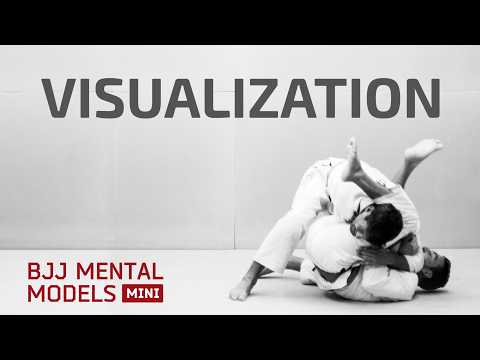
In this week's mini-episode, we discuss the concept of the knee line: an imaginary line connecting your two knees. When the two points of this line combine with your groin, these three points create a triangle. That triangle is the basis for how we use our legs to clamp or wedge our opponent in place.
To clamp or wedge their body part in place with your knees, it should beinsideyour knee+knee+groin triangle. To prevent them from doing the same to you, your body part should beoutsidetheir knee+knee+groin triangle.
Don't forget to check out BJJ Mental Models Premium!
If you love the podcast, you'll definitely love our premium membership offerings. The podcast is truly just the tip of the iceberg – the next steps on your journey are joining our community, downloading our strategy courseware, and working with us to optimize your game. We do all this through memberships that come in at a fraction of the cost of a single private.
Speaker 1: Hey everybody, before we get started this week, I have huge news. She actually did it. We're pleased to announce that Beatrice Jin, top-ranked women's competitor in North America and long-time BJJ Mental Models Premium community member has published her first ever course with us, exclusive to BJJ Mental Models. It's called Stop Being Nice. It's a three-part audio series designed to solve real mindset problems that regular folks experience in Jiu-Jitsu. If you struggle to be aggressive and competitive in Jiu-Jitsu, you'll find the solutions here. If you're already a BJJ Mental Models Premium subscriber, you've already got access, and if you are not, good news, you can get it now and get your first week free, go to BJJmentalmodels.com and check it out today.
Speaker 1: Hey, welcome to BJJ Mental Models. I'm Steve Kwan. BJJ Mental Models is your guide to a conceptual and intelligent Jiu-Jitsu approach. And today's mini episode is about a topic I've been sitting on for a while. I've been trying to figure out the best way to tackle it. I want to talk about the concept of the knee line in Jiu-Jitsu. You've probably heard this before. The idea of the knee line is a very common mental model that is used by a lot of coaches, but I've been struggling for a while about how to present this one properly because the term gets used for a lot of different but sort of related things, and it's been kind of hard to settle on a single definition that I think is really helpful. So, I think I've come up with one now. I'm going to share it here today. I do want to clarify though that like a lot of mental models, the knee line is just an idea, just a way of organizing your thoughts. Your coach or another coach may have taught you a different definition for this concept, and that's okay. I'm not claiming that the way that I think about it is the definitive way to think about it. This is just the way that I conceptualize the knee line and how I use it. It's been helpful for me, so hopefully it'll be helpful for you as well. And specifically, the version of the knee line that I will be talking about is what I think is the most common understanding of this concept. There are other competing understandings of the term, which is part of what makes it difficult to get your head around this. So, for example, Eddie Cummings has a concept of a knee line that he uses to determine which direction you should turn your knee to slip out of a leg lock. That's not what I'm talking about here. I'm talking about a more general concept that, um, for my experience, is the one that most people use. So, let's talk about it. Look down at your legs right now. No, seriously, do it. I, I can tell that you're not. I'm monitoring you through your phone as we speak. Look down at your legs. Okay, so you see you've got two knees, right? Presumably. The imaginary line that connects your two knees is what we would call the knee line. So, if you think of the fact that a line has two points, your knees are the two points of that line, and then there is this imaginary line that passes between them. That's the knee line. Now, why does this matter and why does this help? Well, the idea of a knee line gets used in a lot of different contexts, but what it really tells us, what we're trying to do with the knee line is we're trying to figure out, number one, how can I trap my opponent using my legs? Or, number two, how can I prevent my opponent from using their legs to trap me? That's ultimately what the knee line is about, is how to use your legs either effectively as a weapon for control, or how to prevent your opponent from using your legs against you for the same purpose. So, the knee line comes up in a few different contexts, probably most notably, leg entanglements and guard passing. I'm going to run through how all of this works and how I think about it and tie it together into sort of a single theory. So again, look back down at your legs. You've got your knee line, the imaginary line that passes between your two knees. Now, if we add a third point to that shape, we go from getting a line to a triangle, right? Two points is a line, three points is a triangle. So, imagine your groin is the third part of that triangle. So now you've got this triangle between your legs, right? Your left knee, your right knee, and your groin, and between that, you can imagine there is sort of an invisible triangle. For your opponent, that is the danger zone if you can get them inside that triangle. So, when you are trying to use your legs specifically to trap and control someone, and by that what I mean is you're using your legs to either clamp onto someone or wedge onto them so that you're stuck to them and they can't move. Whenever you're trying to do that, you need the part of their body that you're attacking, you need that to be inside that triangle. This is a great example that Jesse Walker from Rough Hands BJJ actually gave me about how this works in the context of closed guard. If you are inside my closed guard, the thing that makes closed guard work is you need to be inside that triangle between my legs. So my groin, my right knee, my left knee, your torso needs to be inside that. If you are able to back out or posture up or free yourself enough to the point where your torso is no longer inside that triangle, it's not closed guard anymore. Now it's an open guard, and I need to switch strategies because I can't clamp onto you like I would want to do from closed guard. A clamp isn't going to work unless I can keep you inside that triangle. I will need to start looking at switching to something like a butterfly guard or using hooks instead because you're not inside that zone where I can lock onto you and latch you down. Similarly, if I am trying to pass your guard. So for many guard passes, if I want to complete the pass, I need to prevent my knee from getting caught inside that triangle that you've made. If my knee is inside the groin, right knee, left knee triangle between your legs, I'm stuck. And when I start to really pass your guard is when I can get my knee free. People will sometimes call that clearing the knee line, but really I like to think of this triangle concept instead. It's a bit easier for me personally to visualize. So, if I am, say, in your half guard, and you have my knee inside that leg triangle of yours, I am stuck there until I can get my knee free. This also comes up a lot in the context of leg locks, and I'll explain why this matters in a second here. But first, let's talk about the mechanics of the leg and how it works. You may have heard me on BJJ Mental Models talk about what I call the three-joint rule, the idea that our arms and legs are connected and articulated with three major joints. So in the case of your arms, you've got your shoulder, your elbow, your wrist. In the case of your legs, you've got your hip, your knee, and your ankle. The more of those joints that you can lock down and control, the more control you have over your opponent. If I only grab you by, say, your ankle, that's not a ton of control. It's more just a grip, but you still have pretty good motion. It's once I get to the second joint and I start controlling your ankle and your knee, then now you really have problems. And when I can get to the third joint and I can control your hip as well as your ankle and knee, that's when it we're in submission territory. This is when I can actually start going for a finish with high confidence. Imagine what it would be like to try to grapple if you didn't have that middle joint in your leg, your knee in this case. If your leg was basically just a stick, a straight line, and it's connected from your hip and your ankle, but you have no knee that can bend. Your leg is basically just like a stick. In that case, trying to control someone with your legs would be kind of like trying to control them with a pair of chopsticks because you can't bend your legs, you can't wrap them around someone. And if you've ever eaten with chopsticks, you know how challenging that can be. It's hard to just use two sticks to get a good grip on something. And unlike in the case of eating dim sum, in Jiu-Jitsu, your target is actively trying to get out of bad positions. So that makes it even harder to use this kind of chopstick approach where you're using these two sticks. That's why the knee is so important. It's the place where we can bend our legs. That's how we can wrap around someone and clamp onto them. That's what makes our legs effective weapons. This isn't quite as big a concern when you're talking about your arms because we have hands, right? Our hands have the ability to grab and clamp onto things on their own. Whereas with our feet, unless you are some sort of anomaly, you probably can't grab people and wrap your foot around them and use it like you would a hand. So if you want to actually lock onto someone, your knees matter. That's why with so many leg entanglements, the thing that really makes it work is biting with your knees, pinching with your knees, clamping with your knees. That's how you hold a person in position, and it requires that middle joint, that knee, right? And similarly, that's how your opponent escapes, is they free their knee. If you can control them by their knee, then you can control them by the bend in their leg, and that makes it way harder for them to escape. If you can't control them by the knee, again, think of like a pair of chopsticks, right? The, the stick is just going to slip right out of there. It's going to be hard to control. So the knee is very important for both attacking and for defending. When you are attacking a leg entanglement, you generally want to keep people inside your knee line. So again, that means you've got that triangle between your legs. You want to keep their knee inside that triangle. If they are able to slip their knee out of that triangle, now you no longer have control of the bend in their legs, and it's going to be a lot harder just by grabbing their ankle to actually get anything done, especially if they're good at defending. So to just tie all of this up about the knee line, again, it's all about this invisible triangle between your legs. The invisible knee line between your two knees, your groin is the third part. If you're attacking someone, you want to keep the part of their body that you're attacking inside that triangle in your legs. If you're trying to escape or pass or prevent them from controlling you, then you want to keep your vulnerable body parts outside of their triangle instead. So again, let's give some examples. With leg entanglements, most of the time, if I want to control you, I need to have your knee inside that leg triangle between my legs. For guard passing, if I am in your half guard, I need to clear my knee by getting it outside of your leg triangle. As long as my leg is inside that leg triangle of yours, I'm still in half guard. It's once I free that that I start to be able to pass. And Jesse Walker from Rough Hands BJJ actually gave me another example of the knee line that I had never thought about before, and that is closed guard. If you are inside my closed guard, then I need to keep you inside that triangle. Your torso needs to be inside there. That gives me the power to clamp onto you and hold you in my guard. If you're able to back out outside of that triangle, it's no longer closed guard. I have to switch now to open guard because my ability to clamp onto you or wedge you is much more limited if you're outside that triangle. So what do I do? I switch to a different guard like a butterfly guard, uh, where I'm using hooks instead because I can't keep you inside that triangle anymore, and so closed guard isn't viable. Now, all of this of course gets a little bit tricky because your knee line and that leg triangle aren't always the same shape. As you move your body, as you move your legs, the triangle changes shape as well. So you need to always be aware when you're trying to clamp or control someone with your legs, that they stay inside that moving triangle. And understand that because the triangle is moving, you may need to move as well. That's part of the reason why leg locks can be so challenging because when you're transitioning between different leg entanglements or people start rolling, then the position and the shape of that triangle can change, and that gives the person the opportunity to free their knee and get out of the submission or the control point. So, that's my, my general summary for the knee line. Again, I like to think of it as this triangle, and then the knee line is just one part of that. So just to recap that again for memory purposes, think of the knee line as being part of a triangle between your legs. Left knee, right knee, and groin are the three parts of the triangle. If you want to control someone's body part specifically by clamping it down or wedging it, you need to keep the targeted body part inside that triangle in your legs. And the flip side of that is, if you want to protect yourself from your opponent and prevent them from clamping down or wedging onto you in the same manner, then you need to free the attacked body part from their leg triangle. I hope all of that makes sense. I have done my best to try to explain this concept in a way that doesn't require too much geometry or visualization. It is a very powerful tool for understanding and getting out of entanglements and also maintaining your own entanglements. So, think about this, try to get to the point where you can just keep people inside that triangle intuitively, and prevent them from doing the same to you. That will improve a lot of areas of your Jiu-Jitsu, most notably, leg entanglements, guard passing, and closed guard. I hope you found this helpful. If you want more like this, go to BJJmentalmodels.com. We have a ton of full-length podcast episodes that break down concepts in a lot more detail, and we've got a lot more mini episodes just like this that get to the point faster. And please do consider going to Premium with us, joining BJJ Mental Models Premium. That is our subscription service. It is the world's largest library of Jiu-Jitsu audio content, tons of audio courses on strategy, tactics, concepts, mindset, philosophy, plus an increasingly growing library of Jiu-Jitsu audio documentaries. We may be some of the only people in the world really doing this kind of stuff, and I would really appreciate your support because I think it's super helpful. We also offer direct coaching services from some amazing black belts, plus business support if that's what you need as well. You can learn about all of that at BJJmentalmodels.com. So please do check that out if you haven't already. But in the meantime, I just want to thank you sincerely for your support. I know this mini episode was a bit longer than usual, but it's also a slightly more complicated concept with a lot to unpack. I hope you found this helpful and useful. Thank you again for your time, and I'll talk to you soon.