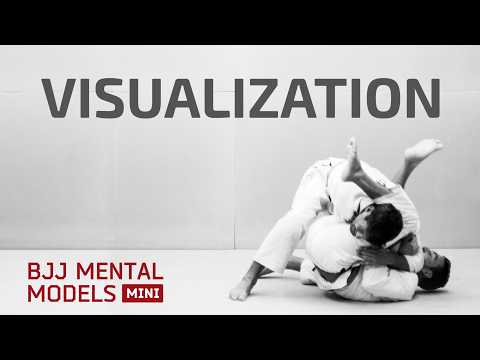
In this week's mini-episode we explain the concept of surface area, or how much of your body is connected to your opponent when you apply force. You can create more pressure by applying maximal force through the smallest surface area. A classic example is the "shoulder of justice" side control crossface pin. We also discuss other benefits to minimizing surface area, and other types of pressure beyond the physics definition.
Don't forget to check out BJJ Mental Models Premium!
If you love the podcast, you'll definitely love our premium membership offerings. The podcast is truly just the tip of the iceberg – the next steps on your journey are joining our community, downloading our strategy courseware, and working with us to optimize your game. We do all this through memberships that come in at a fraction of the cost of a single private.
Speaker 1: Hey everybody, before we get started this week, I have huge news. She actually did it. We're pleased to announce that Beatrice Jin, top-ranked women's competitor in North America and long-time BJJ Mental Models premium community member, has published her first ever course with us, exclusive to BJJ Mental Models. It's called Stop Being Nice. It's a three-part audio series designed to solve real mindset problems that regular folks experience in jiu-jitsu. If you struggle to be aggressive and competitive in jiu-jitsu, you'll find the solutions here. If you're already a BJJ Mental Models premium subscriber, you've already got access, and if you are not, good news, you can get it now and get your first week free, go to BJJ Mental Models.com and check it out today.
Speaker 2: Hey, welcome to BJJ Mental Models. I'm Steve Kwan. BJJ Mental Models is your guide to a conceptual and intelligent jiu-jitsu approach. And in this week's mini episode, let's talk about physics. Let's talk about a concept from physics that is tremendously important to jiu-jitsu, and let's see if we can do this without coming across as overly pretentious. So, today I want to talk about surface area and pressure. In jiu-jitsu, you will hear people talk about the importance of pressure all the time, but most people probably can't actually define what pressure is. If you want to understand how to apply pressure to someone, at least in the definition of pressure that comes from physics, then you need to understand the formula here. Pressure, as defined in physics, is a ratio of force to surface area. The idea is, if I want to create maximum pressure, I put maximum force against you over the smallest surface area possible. This is why if I stab you with a knife, it's going to hurt a lot more than if I stab you with a spoon. There is smaller surface area if I stab you with a knife, right? There's the tip of the knife, whereas the spoon would be a long dull piece of metal. So, even if I use the same force against you, the knife is going to do more damage. That's because it creates more pressure. It's the reason why a pin will pop a balloon, but something that is more dull won't. So, in jiu-jitsu, we can use that same definition, if we want to maximize pressure as it's defined by physics, and I'll talk more about why I keep bringing that up later, then the way that I would do that is I put as much force onto you as I can, in as small a surface area as I can. So, if you want a practical example, if I am pinning you in top side control, if I'm just lying on top of you like a wet blanket, I'm basically relying on gravity to do a lot of the work. That's where a lot of the downward force is coming from. It's gravity dropping my weight onto your body. If I want to turn up the pressure, then I also want to minimize the surface area. I want to make sure that the part of my body delivering the force to you is as small as possible. So, if I'm laying on top of you like a wet blanket, that's a large surface area, so that's not going to be as much pressure as if I'm more surgical, and I only make small points of contact with you. You might have heard of the old shoulder of justice. It's a cross-face position from side control where I drive all of my weight through my shoulder into your jaw. That is an example of creating a lot of pressure because I'm using all of the force from gravity, from driving off the floor, and I'm delivering that into your jaw through the very small surface area of my shoulder. Creating pressure in this way becomes especially important when you are much smaller than your opponent and they are much stronger than you. The reason why is because when you are much smaller than your opponent, you simply can't rely on gravity or even your own strength to do a lot of the heavy lifting when it comes to generating force. A smaller person is really going to struggle to generate as much force as a larger person. So, you can compensate for that by delivering that force through a smaller surface area. That will create more pressure. So, you will notice that with a lot of smaller people, when they are making contact with a bigger person, they're not blanketing on top of them. They're only giving them small surgical parts of their body. So, they will do things like play knee on belly where all of that pressure is coming in through the small surface area of your knee, or they'll do the shoulder of justice where it's all being delivered through the shoulder, a small surface area. What you don't see often when there's a big size disadvantage, you often don't see the smaller person trying to wet blanket the bigger person because they can't generate that much pressure by doing that. And any small person knows if you try to do that, if you let your opponent get hands on you, they can bench press you off. The more surface area you give them, the more opportunities you give them to grab onto you and to escape the position. So, that's another benefit to giving them less surface area of your body. It makes it harder for them to counter your attacks. So, as a smaller person, if you're fighting a bigger person, you always want to look for high-pressure opportunities and techniques. Other examples, beyond the ones that we talked about here, include the knee cut pass. That's a great example because the point of your knee is a great spike to create pressure, to drive through your opponent. So, even if you're small, if you're primarily breaking through your opponent's defenses with your knees and your elbows and other precision points of your body, that's a great way to create a lot of pressure. Now, I mentioned earlier that we were going to talk about why we keep talking about the physics definition of pressure. So, again, as per physics, pressure is defined as a ratio of force to surface area. However, you could argue that there are broader and alternative definitions of pressure, which maybe while not scientific, are still useful when we're training jiu-jitsu. And most of those types of pressure come into psychological forms of pressure. So, examples, uh, Josh Kintanon Wentworth, many time guest on BJJ Mental Models. He actually made a great course with us for small people, which is on BJJ Mental Models Premium. One of the things that he talks about is how movement is its own form of pressure. So, in this situation, you are relying on your ability to stay one step ahead of your opponent to tire them out and create psychological pressure. So, that is not the technical physics-based definition of pressure, but when it comes to how we communicate in jiu-jitsu, people will often refer to heavy movement as a form of pressure. There's also other types of psychological pressure that you can do by attempting moves that demoralize your opponent. You've heard us talk in the past about pit stops and waypoints. There's a lot of things you can do where you can go to positions you're really good at, and you can make your opponent get tired and break their morale by putting them into a position where they struggle to have success, and if they keep failing at that, then they'll get frustrated, they'll get flustered. That in itself could be considered a form of pressure, even though it's not based on physics, it's psychological. But for the purposes of how we communicate in jiu-jitsu, we might still call that pressure. I sometimes do as well. So, there's the way to think about pressure in jiu-jitsu. The actual definition of pressure per physics is a ratio of force applied over surface area. You want maximum force over the smallest surface area to get the most pressure possible. But there's also other types of pressure you can create that are psychological by either moving so much that your opponent tires out or doing things that frustrate and fluster your opponent. Those could be considered psychological forms of pressure. They're just as useful in jiu-jitsu as the physics-based definition. So, there you go, an explanation of surface area in jiu-jitsu and also the different types of pressure. I hope this was helpful. If you want more of this, go to BJJ Mental Models.com to get every episode of our full-length podcast and the minis like this, completely free. You'll also be able to sign up for our newsletter, an amazing resource with over 12,000 subscribers, and it's completely free as well. And of course, if you want to kick this up to the next level, grow your game with us, help build your jiu-jitsu business with us, and if you want to check out that course I mentioned earlier from Josh Wentworth, then go to BJJ Mental Models.com and sign up for BJJ Mental Models Premium. You'll get a full week free, and that'll include all of our courses, plus a bunch of other awesome reasons to join, and you can learn more about that at the website. Thanks a lot for listening, and I'll talk to you in the next one.