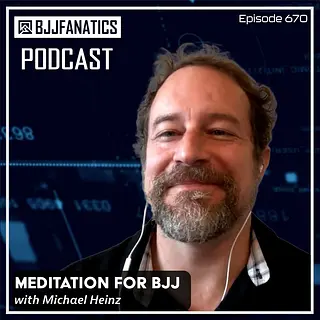
BJJ Black Belt Michael Heinz joins show show to talk about how meditation has impacted his journey in the art. He explains how to use meditation concepts before, during and after training to achieve better results.
Transcript
Show transcript
Speaker 1: Welcome back to the BJJ Fanatics Podcast. I'm your host Ryan Ford. My guest today is a first-degree black belt in Brazilian Jiu-Jitsu. He has his own academy, SPG Texas in New Braunfels, Texas. He's also got a bachelor's in history and a master's in education from Truman State University, and he's also been teaching meditation for over 27 years. Ladies and gentlemen, it's my pleasure to be joined today by Michael Hines. How are you today, Michael?
Speaker 2: I'm doing great. Excellent. Thanks for having me on.
Speaker 1: Of course, of course. I appreciate you taking the time to be here. Michael, uh, if you don't mind, the question I always like to start with with guests, tell us where you're from originally and what your life was like before you found Jiu-Jitsu.
Speaker 2: Great question. Um, so I'm originally from Iowa, and I grew up, I grew up in Iowa, uh, till I was 18. Then I went to school in Missouri, Truman State. Um, from there, and this is all this getting me towards Jiu-Jitsu here. From there, um, I ended up doing a teaching internship in Germany on a, on a military base and spent about six months there and kind of caught a bit of a travel bug. And it ended up living in Japan for two years after that. Um, and then ended up going from there to South Korea, and it was a couple years into me living in South Korea, um, that I, uh, started doing Jiu-Jitsu. That's where I started learning Brazilian Jiu-Jitsu. And, um, yeah, so I'm, it does lead into certain things that, uh, I'm originally from Iowa. So when I started Jiu-Jitsu, everybody was always like, oh, it's like, you're a wrestler. Like, usually that's how Jiu-Jitsu people think, you know, you're from Iowa, oh, you must be a wrestler. That's how you got into it. And the answer is I, I never wrestled, uh, in Iowa. I got, I do have a fun story of getting beat up by when I was maybe, I want to guess somewhere between seven to ten years old by, um, the wrestling, the local, one of the local universities wrestling coaches sons. Like, he, he beat me up and like, mounted me and like, beat me up. And I learned a lot about positional awareness that day, but like, uh, yeah, that that's a fun thing we could get into. But, um, but yeah, that, but never, no, like, you wrestled, and I, I would say you wrestled all the time in Iowa. I, I don't think that's unfair to say that growing up, we had a general, I don't, I mean, I don't know, I don't know what other people's childhoods are like, but, um, from my perspective, Iowa in the 80s and 90s, like, we wrestled all the time on the playground. And we kind of did it because like, if you got in a fight, you would get in trouble. But like, the, the teachers wouldn't really stop you from wrestling. And I don't know if that's an Iowa thing or just an 80s, 90s thing, but like, we wrestled all the time. So, you know, I, I didn't wrestle, but I did wrestle and like, yeah, so.
Speaker 1: Yeah, I was, I was gonna say if you, if you're from Iowa, you at least know something. That's like being from Brazil and you don't know how to kick a soccer ball. Like, for sure. If you're in Iowa, if you're in Iowa and you at least know a little bit of something. Now, when you, when you were talking about the coach's sons beating you up, was this in a, in a, on the mats or was this in a, in a street fight situation?
Speaker 2: Oh, this is a, a street fight, a kid fight, you know, like a playground fight.
Speaker 1: Okay, gotcha. You guys were kids. Okay, okay, okay.
Speaker 2: We were punching each other. Like, we were fighting, you know, like, it was a full fight. And like, what he did, I, I, it started over something completely stupid. Like, what it really started over was I, he was gonna fight another kid and I made a comment about it. And I was known as, uh, there were three Mikes in my neighborhood, but I was Little Mike. I was the youngest. So, um, I've had a lot of different nicknames over the course of my life. And, uh, that was the first one was Little Mike. So, naturally, in the heat of the moment, it was much more, uh, encouraging for him to switch to fighting me instead of the person he was going to fight. Is that the smallest kid on the block and like, the youngest kid on the block. And so, then he, he like, took me down like, very quickly. I have no idea. I couldn't tell you how he did it. I, I don't remember that. What I do remember was that he mounted me and started punching me in the face over and over again. And I was like, this is, all I could think on the bottom, I remember first thinking this is so unfair. Like, I, I'm never, like, I don't know what to do here. Like, I can't get out. Like, I tried to punch him back. I couldn't. I think he was sitting on my arms. And he punched me over and over. I remember that how I got out was I said something like, uh, I have to go home early for lunch or something. My parents are gonna be mad. And in, in true childhood logic, he let me out and, uh, I left crying, I'm sure, like, bawling my eyes out. But I, I do take it, I talk about this in my class sometimes. I take it as the first moment in that I really learned Jiu-Jitsu. Because I, I started a positional awareness. And, um, I, I, I definitely reflected on it. I was like, that position, I guess I would have called it mount. I don't know. But like, I don't know what I called it in my mind, but I remembered the position. And about, I, I don't know, a year or two later, a, a kid much, much, much bigger than me. Like, considerably larger than me picked a fight with me. And it was almost an identical situation. He was supposed to fight someone else and then I just happened to be there. And I don't know if I said something. I guess I was a bit of a smart ass. But, um, he, he decided to pick the fight with me instead. I, I really can't emphasize enough how much larger this kid was than me. He was older than me. And what I did in the fight, I'm very proud of this. I mean, it's a very young kid, but I didn't fight fair. I knew that that wasn't gonna work because I'd already been beaten up multiple times by people who quote, didn't fight fair, you know, and I, I realized no one's gonna save me. No one's gonna come in and help me. So I remember I did something like, he threw a punch at me. I twisted it behind his back in a kind of Kimura type structure. And then just punched him in the shoulder. The, the, the shoulder that I had pinned over and over again. And then I actually people, surprisingly, people did actually break it up. They're like, that's not fair or whatever. And then we went at it again. He threw, he threw the left instead. I twisted that one behind his arm, behind his back and punched him in the shoulder over and over again. I remember he grabbed me, like, again, people like, kind of separated us or something. He grabbed me and ended up slamming me into a tree. And I remember somewhere in that, we ended up falling to the ground. And as we started to hit the ground, I knew exactly where I wanted to be based on having been beat up there before. I jumped to mount. And I, I beat, beat him. I mean, I just beat him like, over and over from there. And, and I became, I won't say the kid's name because he's a grown man somewhere and he doesn't deserve that. But like, but I became known as the, the, the little kid who beat up so and so. Like, and like, and I became almost like a bad guy by the end of it because I was just pounding him from the top. And people were like, it's not fair. You're beating him up. He went home crying and stuff. I'm sure it was a very bad day for him. He picked the fight to be frank though. Like, I, I certainly had no interest in being in the fight. He started it from the very beginning to the end. And yeah, I mean, I just like, I, like, people were kind of like, in awe that I beat him. I was quite a bit smaller than him. But it was totally, from the perspective now, the vantage point many years later, you know, 40 some years later or whatever, it's like, it was Jiu-Jitsu. It was, it was a kind of Jiu-Jitsu. I'd use positional dominance to, to beat someone bigger, stronger, like, I don't know about faster. He was kind of overweight. But like, but like, he was bigger. Like, by far. If I'd let him been on top of me, it would have been over for sure. Like, so.
Speaker 1: That, that phase of life as a young boy, I mean, obviously like going through bullying and stuff is horrible. But the idea of just getting into like playground scraps and things like that. That really is a, it's a formative, it's a really important phase in the kids. I mean, it teaches you so much about life and about yourself and how to, what you're worth and, and how to stick up for yourself. Even if you don't win, you just, you learn how to stand up for yourself. I wish kids reasoning, like you mentioned earlier, was something that still worked. Like, imagine like you're getting robbed and you say, I have to go home early for lunch and they just let you go. His mom, his mom's making him a sandwich. We gotta let him go. But, uh,
Speaker 2: I mean, I think, I think he was kind of like, I've already beat, he'd already beat the snot out of me. So, I, I don't think he had anything, he knew he didn't like, there was nothing left to do. Like, he would have just bloodied me up and then he would have got in trouble at that point. I think we had a really good sense of that as kids that like, you would win and you knew like, if you took it a little too far, there was gonna be trouble with parents and stuff. If you beat him up, maybe a little bruise, you were okay. Like, but if you really like, made someone bleed pretty bad, everybody knew you were gonna get in some real trouble for that. So, that, that kind of acted as a nice, uh, buffer. So, I don't think we ever really, we fought a lot, but I don't remember anyone really getting that hurt except on a few occasions. I can remember some pretty gnarly outcomes. But overall, you know, you kind of like, it would be like headlock, all the stuff that someone teaches in a very basic Jiu-Jitsu course, where it's like, headlock, punch him over and over again, like 75% of schoolyard scraps. It's like, who got to the headlock first?
Speaker 1: Yeah, exactly. Yeah.
Speaker 2: Tactical nuclear warfare.
Speaker 1: Yeah, yeah. No, the playgrounds are definitely the streets. Those definitely, that definitely qualifies as the streets for sure. And we were talking about that phase too in young men. That's, I think another thing that that does for a lot of people is when they get involved in martial arts later on, it's not such a shock. There's some people that you can tell when they first start boxing or doing MMA or, or training Jiu-Jitsu, it's their first time really going hands on with another human being. There's, there's a little bit of a, of a, of a, uh, like a, a process they have to go through to get comfortable with that.
Speaker 2: 100%.
Speaker 1: When you found, I, I imagine when you found Jiu-Jitsu, when you started training martial arts, it was something that you probably felt pretty natural to you since you'd been hands on with people as a kid.
Speaker 2: Sure. Yeah. I mean, I was like, 28 years old by the time I found Jiu-Jitsu. Yeah. And, um, my experience was, I used to, I used to host, uh, fight watching parties at my apartment when I lived in Seoul, South Korea. And, um, a guy had come to one of the parties, a friend of mine, Riley, and he just was like, hey, you know, they, they do this up the street. You can come learn this. And, um, I went up and gave it a try. And it was, it's what I call Generation 2 induction into, uh, Jiu-Jitsu. I learned like, a technique. I remember what it was. It was a cross collar choke from mount. And I thought like, okay, like, I don't know, how, okay, like, you know, like, how would I ever get to that? But okay, sure. Like, it was, I was like, it was cool. I thought it was cool. I remember even who taught me, um, Kim Kookchu. But, uh, runs a very successful, uh, gym over in Korea still. He wasn't my, my head coach or anything. He was just like, a purple belt at the time, but he's probably second or third degree black belt now. Um, his English was a little shaky, but he, he got the job done. And then it was like, all right, here's like, a murderers row of these blue and purple belts that were all guys that were winning like, Pan Asian tournaments and stuff like that. And they just were like, you know, you, you, you touch hands, bump fists. And then it was like, I don't even really know what I was supposed to be doing, but they just, they tore me apart. And, uh, it was very smooth. One thing about, uh, martial arts in Korea, I think is, um, definitely smooth. Guys, guys are very dedicated to being martial artists, not just to being like, tough guys for the most part. And so, um, I was just blown away. About an hour of just getting thrashed in, in a variety of situations. Just, just grappling, just Jiu-Jitsu. It wasn't what I call Gen 1. Gen 1 induction to Jiu-Jitsu was like, you can do anything you want. And the other guy just beats you up or whatever. The, the old Gracie induction, which is super cool, but I'm glad I don't have to do that on a daily basis, honestly. But, uh, yeah, it was Gen 2. And, um, I walked away and I, all I could, I remember the exact thought I had, which I had two thoughts that, that really stuck with me. One was, it really reminded me of wrestling with my older brother when I was a kid. And I felt that it was scratching an itch in my soul that I didn't know that existed. And I really do believe that, um, I mean, I don't think you, I think you'd be hard pressed to find mammals, uh, that don't wrestle around even if they're herbivores and stuff like that. And, and their, if they have any sort of childhood where they're, or infancy stage where they're fairly small and they're with other peers and things like that, they'll, they'll wrestle around. Um, and the more predatory they are, the more frequently they're gonna engage in that kind of behavior. I mean, I'm not a, uh, a zoologist or something. So, like, I, I'm sure you could find some exceptions to that and, and make me look dumb. But I, I think it's relatively, uh, consistent and relatively common. So, I think it's there in humans. We are predators. And I think, you know, one of the main things that kills us is humans. So, like, uh, wrestling around with other humans is clearly something I think we did for millions of years. And I think there is a sort of, uh, scratchable surface somewhere in our soul that when we do this, feels right, feels good, feels, and I remember very much feeling that the first time I did it. And like, I, I hadn't wrestled with people in years. So, it felt like, amazing. And then the other thought I had, which was very clear in my mind was, um, because I'd played around with a variety of martial arts. Never anything terribly deep. Um, but I'd tried a variety of things. And, uh, I remember walking away being like, those guys are real ninjas. Like, they are real. Like, that was real. Like, there was never, like, all the other martial arts I'd played around with before, I had a lot of fun with. I really enjoyed them. But I would say there was always a slight hanging doubt of like, would this work? Could this work? I really felt like I had to, I had to like, stretch my mind to believe that, yeah, it would work. I, and I believed. I, I grew up on like, Kung Fu movies and like, all the Shaolin, Wu Tang stuff. I loved all that. So, I believed. This is as like, a full believer, like, absolute believer. But the, I felt the most substantial difference that day when, I don't know, five or six blue and purple belts just destroyed me was, um, I didn't feel the burden of belief. I felt like there was such an absolute reality to like, I gave them everything I had. I, no one told me to like, go easy. Nobody was like, hey, relax. Like, it was just like, they didn't care. They, they, they weren't even the least bit troubled by what I could do to them, which was nothing. Um, at all. And it totally reordered my whole idea of myself as a man too. Like, I thought, like, these are real ninjas. I'm nowhere near as tough as I thought I was. Like, I, I'm not even in the ballpark of where I thought I was. I thought, ah, I grew up wrestling with guys and I have a pretty tough guy or whatever. I'm not even, not in the same sport of where I thought I was. And I want to be those guys. And I'm gonna keep going until I'm like, a blue or a purple belt. If I could just be a blue or a purple belt and be able to do to those, do to other people what those guys could do to me, that would just be the most spectacular thing. I, I couldn't believe that I could achieve that in that moment in truth. I, I thought that is the highest attainable goal with fighting that I could ever achieve. I would have never guessed that I could become like, a first degree black belt or something. And I really believe, I was talking about this with another black belt, like, and this is, I guess, black belt talk or whatever. But, and if you, if you're not a black belt and you're listening to this, it, it won't entirely make sense to you until you become a black belt. But, um, and just keep going and you will. But, uh, in my mind, I can't believe that I could take a time machine back and fight all those guys and beat them. In my mind, they exist forever as these like, impossibly tough, Olympian level gods that just came down and whipped the crap out of me. And I could never, ever beat them. I, I, I suspect I probably could or it might not have even, it might not even be that challenging for me. I don't know. Like, I, I, but I can't believe that. Like, even when I, just saying that right now, grated against everything in my soul to like, try to say like, I know that it might not be the case because I roll blues and purples and, and beat them all the time. But it's like, it doesn't, there's a, there's a ring of untruth to that. And I, I do remember, um, you know, these guys just whipping me. And then I remember my coach, John Frankl, my coach, John Frankl is a Korean literature professor. But he's the person who brought Brazilian Jiu-Jitsu to South Korea. He'd make a great guest, by the way. Um, and, uh, John's just not around all the time. Like, like, he, he, I mean, like, he probably trains four or five times a week. But just in those days, we were in the university like, Judo mats. And, um, it wasn't very organized. Kind of when we showed up, whoever was the highest belt taught something and then we rolled. Like, that was, that was basically a day in the life at Yonsei University circa 2008, 2009. And, um, every now and again, John would show up. And like, and teach a proper class. And it was like, just blow my mind with like, positional awareness and all these kinds of things. Like, actual, and also in English, by the way. Because most of, most of the time when I would go to learn, it was in Korean with a smattering of broken English like, kind of to help you along. So, I learned a lot of my Jiu-Jitsu in Korean. And my Korean is not that good. So, uh, it was hard. It was a lot of just monkey see, monkey do. And John would come and John's Korean, he's fully fluent. So, he will teach in Korean, but then he'll throw the dog a bone with a little bit of English for the rest of the, the, what you would call Waygukin, the, the foreigners who were there and stuff like that. Of which there's always a couple. And, um, yeah, the, like, I remember then watching him roll with the blues and purples that were so good in my mind, like, impossibly good. You couldn't do anything to them. One guy I, I deduced that the only, like, if I, wherever I put my hand, he put me in an armlock. So, I realized just don't, don't touch Pyongyu. That was the, that's what you do to avoid, to avoid being armlocked, you just don't touch him. That, that's how that works. And, uh, lead with your feet or something. Like, there was just no, seemingly no way I could, I remember just trying like, I'd be like, oh, let's start with, I'll touch his knees and try to control him. No. I'm gonna maybe I'll go to the hips. No. Maybe I'll go to the ankles. No. Like, I guess the shoulders. No. I'll try to grab his hands. No. Like, nothing. Grab his head. Didn't, I remember just one day just trying to start in all these different ways and nothing ever worked. I just ended up in some sort of armlock, armbar, reverse armlock. He's very good, by the way. He's very, very good. Uh, I think he's like, John's fastest purple belt. But, uh, he was, he was truly exceptional. And, um, but yeah, I remember John showing up and just ragdolling them all. And just watching it, that was a moment of just utter disbelief. Just watching like, these guys are so good. I could, at first, I thought they were just like, playing or they were letting him or something like that. And he was making it look easy. That was what was so weird. It was like, it, it was decipherable on some level. You're looking at it thinking like, oh, well, yeah, yeah, well, yeah, yeah, like, I guess, yeah, you put your knee there. Like, yeah, that works. Like, yeah, like, it's weird how your mind does that when you watch someone so much better thrash someone. And like, you're like, in Jiu-Jitsu, and you think like, in your mind's going like, oh, well, yeah, well, I guess that's what I would do. In reality is you wouldn't. Like, not really. Like, you watch Gordon Ryan beat some of these guys and like, it's easy to forget that he's beating someone who's like, a world champion.
Speaker 1: Right. Exactly.
Speaker 2: But you'll watch it and it's not indecipherable much of the time. It's not like he just does something completely like, like, you've, if you've done Jiu-Jitsu at all, like, several years, like, you're like, oh, yeah, yeah, knee on belly or something. Like, you're like, oh, yeah, yeah, yeah, armbar. Like, it's not like he's playing with a, a set of vocabulary and words that you've never heard, you know, like, like, you know what I mean? Like, it's, it's all decipherable. But like, you could be, uh, and I think you could be greatly forgiven for like, watching him beat someone like, Andre Galvao and think like, I guess I could do that to Andre Galvao. And I just met Andre Galvao like, about a month ago. And I'm just gonna go right ahead and say, I don't know who you are listening to this, but I'm gonna just tell you, you, you're not gonna do that to Andre Galvao. Like, I'll, I'll, I'd take that bet. I, I maybe there's the 1% of you listening that could, but I'm gonna guess the 99% of you that are listening could not. And, and but, yeah, and I, I trained with Gordon, I, I do go up to Gordon's gym. It's not too far away. And, um, I go up there every now and again. And, uh, yeah, I mean, he's, he's amazing. Like, incredible. And, uh, just like, yeah. And then, and then also recently, I trained with Andre Galvao. They're both incredible and great. And like, yeah, it's, it's different. I mean, just levels on things like, that are hard to even comprehend really. But anyways,
Speaker 1: That's awesome. It is. I, I really like that thought that you shared when you were talking about how if you could get in a time machine and go back with your current knowledge and abilities and train with people that used to smear the floor with you. That's an interesting thought because yeah, it is easy to forget that like, you kind of, you do kind of put someone on a pedestal when you're first learning because they're so significantly ahead of you. Um, and I remember I, I shared a similar experience when I first came into, to Jiu-Jitsu. I thought, okay, I, I at least know how to, how to fight a little bit. Like, you know, I'm not, I'm not like a, I'm not like a, a baby seal here. And I remember they put me with the first two rolls I did. The first one was with, was with a girl. Uh, she was a 130 pound purple belt. I've told this story on the show a lot of times. But, uh, the 130 pound purple belt girl, dude, it was like trying to pin down a squirrel, first of all. She was, I couldn't do, I couldn't keep her off my back to save my life. And she tapped me over and over and over. And that's when I was like, oh my God, man, I gotta learn this. Then the next one was with like, a 125 pound computer programmer, dude. And same idea. You mentioned how when you leave, you're like, dude, these people are ninjas. It made me realize these, these are real people walking the earth. Like, I, I stand next to these people in line at the bank and probably just assume, oh, this is like, yeah, if I ever had to fight this dude, like, it'd be over for him. Little do I know that he would absolutely murder me in like, a hundred different ways. So, there is that, there is that, uh, that healthy, uh, recalibration of your ego and of your, of your self perspective that happens when you first start training.
Speaker 2: Matt Thornton, the head of SPG, obviously, you know, he has a lot of, has been in the, this fight game for a long time and published a lot of great works. But, um, one thing that he said, and Matt and I are good buddies and, and, um, one thing that he said that I really like is, people have no idea that they're walking around with lions.
Speaker 1: Yeah. Yeah.
Speaker 2: And, and it is about the equivalent of like, an African lion. Like, like, they're, they're, they're standing next to someone and they think like, yeah, you know, I could push this guy around or something. And it's like, that person is actually a very good person because he could just maul people like, here and there, you know, like, and every now and again, people poke lions. Just like, in safaris, sometimes people poke lions and find out like, in the real world, I mean, these are some of my favorite YouTube videos is like, people poke lions and I can't, I always forget his name, but, um, there's some kickboxer, some guy like, just bumped into him in like, a bar and,
Speaker 1: Oh, yeah, that was, uh, that was, um, uh,
Speaker 2: Everybody knows this one.
Speaker 1: Joe, Joe, um, Joe Schilling.
Speaker 2: Yeah. And that's the one where Matt commented on that. He's like, you walk, some people don't know they're walking around with lions. And like, Joe, the look on Joe Schilling's face when the guy starts like, smack talking him is he's just like, like, he's clearly, he is so clearly ready to let it go in the beginning. You know what I mean? Like, he's like, apologetic even though he's not the person who bumped into the guy. He was just walking. And the other, he's like, hey, sorry, you know, like, and he didn't do anything wrong. And then the guy's like, yeah, yeah, yeah. And it's like, boom, boom, two piece combo. That guy's probably out for the next hour, you know, like, and just, I mean, it's just kind of, yeah, I don't know. I don't run my mouth anywhere. I'm, I'm like, I consider myself more of a D&D nerd than I do like, a Jiu-Jitsu guy on some level. I know what I can do, but I just don't, I don't know. I don't identify as like, I gotta like, go and get people or whatever. So, I find most guys that are pretty tough don't, you know.
Speaker 1: I found that like, the, the most dangerous people, the most highly accomplished and skilled people I've met over the years are always like, the most friendly and nice, easy, like, the most approachable people. It's usually, it's, it's usually if someone, if someone's putting on some kind of front of being a hard ass, I can usually, usually I can say, yeah, this guy's trying to compensate for a lack of something, you know. So.
Speaker 2: Sure. Just insecurity. Just insecurity. They don't know. They, they don't know. So, they have to kind of puff up. But I think the guys that know, it's like, they don't have any real need to prove anything, you know.
Speaker 1: Yeah.
Speaker 2: And yeah, if you're in the fight world long enough, there's people that have beaten you. So, you know enough to know that there could be, maybe I'm standing, maybe I'm the lion and I'm standing next to the, uh, to the, what is it, the, the Great White Shark riding on the elephant with a machine gun, you know, like, I, I don't know what I, maybe I'm just an African lion in that, in that odd scenario, you know. So, it's like, yeah.
Speaker 1: Yeah, yeah. No, it's like you said, there's levels. And that's another thing that's blown my mind too is like, I've rolled with like, like, instructors of mine and things like that. And they just, of course, smear me. And then they tell stories about how their instructor smears them to this day. And it's just like,
Speaker 2: For sure. Yeah.
Speaker 1: It's like, okay, I'm, I'm working my ass off to get anywhere close to your level. You're telling me there's this other echelon above you and above him and above him. So, it, it really is a never-ending pursuit. And that's, that's part of what's so cool about Jiu-Jitsu. Like, it would be a boring pursuit if you eventually just got to a level where it's like, okay, that's it. Congratulations. You, you beat the game. It's kind of like, I'm glad there's that never-ending pursuit to this because it's something to do for the rest of your life. Um, you mentioned working with John Frankl, your, your instructor, John Frankl and, and, um, living in South Korea. What, what's the, have you been to South Korea lately? Like, what's the, what's the Jiu-Jitsu scene like there? Because I've seen a lot of talent coming out of South Korea.
Speaker 2: Oh, yeah. So, um, I mean, I left South Korea, I think it's now six, six years ago. Pretty close to just exactly six years ago. Um, I lived there for 13 and a half years. I watched the rise of Jiu-Jitsu there. I really could not comment on anything within the last six years except what my coach, who still lives there, would relate to me. Um, I can tell you like, in 2008, when I started, I think there were only three possible locations to do any Jiu-Jitsu. Um, Yonsei University, there was a gym in Apgujeong, and then I think, and then there was a gym down in Busan. Apgujeong is a, a region of, uh, Seoul. It's like, it's a part of Gangnam. So, you know, like, Gangnam Style, all that. It's kind of like saying, um, it's kind of like saying, um, uh, Manhattan or something like that. So, there was, there was like, a, there was a, a studio in Manhattan that was under John Frankl. And maybe one other, one other one that was like, a kind of offshoot or whatever. But John's the one who brought it to Korea. He brought Brazilian Jiu-Jitsu to Korea. Um, and he, but he did that in like, 1999, I think. So, I didn't get around to this till 2008. Yeah, it was like, three or four places that you could learn anywhere. There were like, three black belts in the whole country. And then it was like, maybe move forward four or five years and there were maybe 10 to 15 places in Seoul. Most of them run by people I knew. Guys that were those purple belts that smeared me. They were now all black belts and running gyms. And then you move closer to, what did I leave in? I left in 2019. By the time I left in 2019, it was the fastest growing sport in Korea. Whenever you got off a subway stop, of which there are a lot in Seoul. There is a lot of subway stops. I don't know, 50 of them or something. Everywhere I would look, I always see in Korean, Jiu-Jitsu, like, up on a, on a sign or whatever. So, almost every subway stop, you could find a Jiu-Jitsu place. A lot of times you'd find John Frankl Jiu-Jitsu as well. Like, it's very, I think, I feel like the last time I asked John, how many affiliates do you think you have now? It's, I think, a hundred or a hundred plus maybe. Way, a lot outside of Seoul and stuff, and Daegu and all these other places. So, and then there's like, Checkmat and you'll see Gracie, I know Gracie University had one before I left that was down in like, that Manhattan, Gangnam type region. It seemed like it was run really well. One of my graduate school students went there. Um, a lot of different organizations there now at this point. Um, yeah, it's not hard to find. Yeah.
Speaker 1: Awesome. Strong scene. Yeah. I, I've been hearing a lot, I've been seeing a lot of talent coming out of there and I've been hearing a lot about, about the growth. I was talking not long ago, I guess about a year ago to Higan Machado. And he was talking about how he went there to do a seminar and he'd never seen a welcoming party like they said, like, literally they had billboards, billboards on the highway with his picture welcoming him and he,
Speaker 2: Oh, interesting, huh?
Speaker 1: Yeah, he said they literally took out a billboard to welcome him as he's driving in.
Speaker 2: Oh, wow, huh? I wonder.
Speaker 1: He said they take it, they take it real serious. Yeah.
Speaker 2: Yeah, yeah. I mean, when I left, one thing I'd be very curious to know that I just don't have the answer. I don't think the leg lock scene has yet really exploded there. Um, what was very popular in terms of style, uh, that really took off. And I think this is that kind of martial art ideal. Like, as opposed to, like, there, there were also MMA gyms and stuff like that that were taking off. You know, like, Korean Zombie and stuff like that. He trained at my gym, uh, for a period and stuff.
Speaker 1: Cool.
Speaker 2: Um, I didn't train with him. I only met him one night like, out, we were out for drinks or whatever. I ran into him and stuff, took a photo with him. He was kind of just up and coming at that time. But, you know, he was enough that you knew who he was. I think he was there various maybe Saturday training sessions. Korean Top Team used to come in and train with us. But they just all came in in white t-shirts and like, white, red shorts or something. They all had like, the same, it was just like, they came in like, in plain clothes. He would have just been another guy. I, I might have met him, but I don't, nobody would have, he would have just been Chan Sung Jung at that point. Just another guy. And, um, but anyways, uh, MMA scene definitely has grown. So, that, that, that's there. But, by and large, people don't train Jiu-Jitsu for self-defense. And that idea is not particularly prominent. Seoul is so safe and so, it just wouldn't occur to most people the idea that you're gonna get like, robbed or attacked or something like that. It's, it's unbelievably, like, people almost can't conceive of how safe it is in like, Seoul, South Korea or Tokyo, Japan or something. Which is not to say the same of all the rest of East Asia or Southeast Asia. But like, in East Asia, like, Korea and Japan are just unbelievably safe places with very, very low crime. So, people don't concern themselves with self-defense. I'm not saying stuff happens, of course. Crimes happen. But like, they're fairly insignificant. Um, the feeling of danger is almost nothing. You could walk around at 2:00 in the morning, you wouldn't feel concerned.
Speaker 1: That must be nice.
Speaker 2: That was nice. I mean, yeah, it's one of the nice things about living there. Yeah, when you're there, like, you never concern yourself with things like that. Um, and, uh, so, people are just dedicated to the arts. And they love, everything was Gi Jiu-Jitsu when I was there. No Gi was kind of pulling teeth to get people to do No Gi with some exceptions. But, like, Gi was everything. Loved the Gi grips. Loved like, kind of spider, lasso type guards. A lot of berimbolo. A lot of the best berimbolo guys coming out of there. A lot of them were guys that I came up with. Like, people I know. They might have been at my wedding. Um, like, Wongi or something like that. Like, you know, they, they love it. They love the look of the, they love the look of the berimbolo. Like, it's such a cool idea. I think, you know, some of those guys, unfortunately, their necks aren't doing super well because of like, berimboloing at a high level and like, the damage it can do. So, careful kids with your berimbolos. But like, I, I've seen it firsthand as like, trouble like, guys that are like, 28, 29, having surgery on their neck. It's quite a sad thing. Um, but it's not that it's like, I'm not saying, hey, don't ever do it or something like that or it's bad. But, but, you know, be aware of how you use your body and, uh, the kinds of situations you put yourself in and how stubborn you might or might not want to be. And what is it worth? And where, where is it gonna take you sort of. So, if you're just doing it to get in shape, certain ideas might not be the best ideas for you. So,
Speaker 1: Yeah. I'm learning that lesson myself. I'm actually sidelined right now with a neck injury. I've been out for about six, almost six months. Yeah, I've learned that the hard way too. I'm, I'm coming back. I don't need surgery. Thank God. Nothing like that. But I did have some herniated discs and stuff. And it's made me realize I'm 40 now. It's made me realize I should probably take a new look at restructuring my game a little bit differently. I shouldn't be inverting so much with larger people. I should probably, a little more half guard, a little more, uh, being a little more conscious of my posture and my spine, you know.
Speaker 2: Yeah. Yeah. Yeah. I turned 46 in like, a week. And it's, you know, it's something you have to consider in the for your longevity with Jiu-Jitsu is, and you, I think you have to really decide where you're going with this. And like, like, if you look, if you're trying to be a high level competitor and that's something, I, it'll be a totally different conversation. When I go up to Kingsway, if I were to talk to one of the young guys up there, some 20 year old fire breather or whatever, who's trying to, you know, like, I wouldn't even have the conversation with him on some level because it's not, he's like, I'm gonna go do this seven hours a day, every day. And I'm trying to reach the, what is it, the Olympian heights or whatever, the greatest heights that I can or whatever. So, like, in his sense, and then if that's worth it to him and he believes in that, then, then he should probably, he's gonna have to take the risks, you know. But if you're like, an accountant or something and you're doing this on the side, you might think about, uh, what do you want to do with this? And, and what are the things like, you know, follow your coach, trust your coach. But, um, sometimes just, just sheer stubbornness, you know, like, a brief aside, but, uh, if someone's listening to this and it helps them and saves them from, uh, injury later, um, I mean, I was just up training with the pros. And, uh, big strong guy, much bigger than me, heavyweight. And he got my neck. And I've had a perfect Darce defense for like, six years. No one's Darced me. And I did exactly what I was doing. And he just squeezed, he didn't really, it wasn't just squeeze. He just did something. And it wasn't choking me in the least. But it was tweaking my neck in a way that I really didn't like. And I could feel like, a twisting in my vertebrae that I just didn't like. And it wasn't choke, it wasn't a choke. And I just tapped. And after I tapped, I didn't do the move of being like, hey, bro, that was a crank, not a choke. I was like, you know what, this, this Darce defense, I, I do think it works really well. I got like, six, seven years out of it that no one's gotten me. But like, let's try not to get into those Darces. You know, like, and like, it's not invalid in, if, if we go back to the old school and we're like, well, it was a crank and not a choke. It's like, in the old school, it was something that was going to do egregious harm to me. So, let's not be there. Let's not get hurt. Let's not fight our way through those things unnecessarily. Certainly not in a training room like, with nothing on the line except maybe I get out of that and then tomorrow I'm going to the chiropractor and I'm out for a couple weeks of doing the thing that I love and everything. So, I think a little, a little wisdom there is big. I mean, I, I just met Gary Tonon for the first time recently. And like,
Speaker 1: Oh, he's great. Yeah.
Speaker 2: Yeah, one of the great comments I like from him, he was like, people talk about ego-less rolling or whatever. He's like, I'll tap like, seven times in a seven minute roll or whatever. And that's like, kind of incredible coming from him. I'm sure if he just wants to put the sauce on most people, he just cream them, you know. Like, but, uh, yeah, it's like, what do you have to gain? And what, what is your purpose when you're training? Because training should be about training. It's not really about winning. It's about improvement. So, what are you doing to improve? Like, and, um, I don't know. Holding on as someone nearly breaks your neck just because you're not going unconscious. I don't know if that's the best use of your training time, especially if you only get in the gym a little bit. So, yeah.
Speaker 1: Yeah. So, guys, if you're out there and you want to improve your, your takedown game, I really do highly recommend this one. Again, it's called Takedowns for the Rest of Us. It's available right now at BJJFanatics.com. Uh, Michael, man, in closing, what are, what are some of your major goals for 2026? What are some things you hope to accomplish?
Speaker 2: For 2026, uh, I should have two more Fanatics series out right at the start, around the start of the year. Um, I'm filming them right now. One is, uh, meditation for grapplers. And then the other one is, I haven't thought up the cool pithy name, but if you look up my name, Michael Hines, you'll probably find it. But I'm, I'm filming my foundations program, uh, and I'm gonna put it on Fanatics. I'm working that out with Zenga. And, uh, basically, you know, it's what people learn when they come into my gym to get started. And I consider it the best of Jiu-Jitsu for surviving getting your head smashed in or, um, you know, getting away from a dangerous situation. And I think, um, I think it, you know, I, again, I don't necessarily think there's Jiu-Jitsu in there that, none of that, none of it is something that I just like, invented or something like that. What I do think I have a particular way of putting things together that helps people learn things pretty quickly, pretty, uh, pretty easily. Just the academic background, the master's in education. These are the things that I see as my strong suits more than like, uh, uh, yeah, and I think just that foundation, that's that's definitely for 2026 is, you know, I, I, I wanna create some clever Texas name or something. I don't know. I'm still thinking on that. Like, I feel like I had something the other day and then it slipped away from me. But, you know, I meditate, like, meditation for grapplers is big. I've been, been working on, working out the ins and outs of doing. I just have to sit down and really record it. Yeah, I'm trying to think other, otherwise, like, 2026, you know, just keep trying to make my own guys, all the guys and gals at my gym better. Keep making all the kids at my gym better. Serving them as best I can. Making them the, the best people that I can make them, uh, through my small contributions as a coach. Those are the things that get me up in the morning and stuff like that. Uh, I'll probably go somewhere overseas again. I, I, I like to coach overseas somewhere at least once a year and stuff. So, I'll, I'll, I'll set something up. I don't know. Last year, this year, I sorry, this year I did the UK. The year, or sorry, this year I did, uh, England. The last year I did Ireland. Yeah, I don't know. I really would love to go do, teach Jiu-Jitsu in India. That's like, something, but I don't have any contacts. So, if you're watching this and you have some Indian gym and you like my stuff, hey, I, I, dude, I would love to come in there. I do not travel and coach to make a bunch of money. It's, it's not, that's not what's gonna happen there. But, uh, that's not what I'm interested in. I just like getting out, seeing other people, getting other parts of the world. I like to travel. So, I just kind of combines two things that I like doing. Um, but man, I would love to, I know it's growing in India. And I would love to go see what the Indian scene is like or whatever. Um, but yeah, I just don't have, I, I have zero contacts in that part of the world from the Jiu-Jitsu perspective. I just don't know anyone. So,
Speaker 1: Yeah. Well, we, we've got a big global audience here. So, if you guys are listening from India, send, send, send Michael a message. That would be awesome.
Speaker 2: Sure. Info@spgnewbraunfels.com. And you know, I'll happily figure something out with you guys. That would be great.
Speaker 1: Well, folks, unfortunately, we're fresh out of time. Michael, man, I've really enjoyed this conversation a lot. You have a really cool story. You have a really cool journey that you've been on through Jiu-Jitsu and through meditation. And, uh, you really shared some really interesting perspectives today. You're welcome back on the show anytime you'd like to come back.
Speaker 2: Oh, great. Thank you. Thank you very much. I had a great time. Um, just like everyone, I love talking about myself. So,
Speaker 1: It was, it was a lot of fun, my friend.
Speaker 2: It's easy. Right. Yeah.
Speaker 1: Yeah, I appreciate it. For, for anyone out there that wants to keep up with Michael, it's, it's really easy to do so. He's active on Facebook. You can find him there. His Instagram is SPG_Texas. Uh, his YouTube channel is SPG New Braunfels BJJ. Uh, if you guys are ever traveling through Texas, drop into his academy. It's a great, a great academy, good group of people. You'll get some great, great training. If you can't make it to, to, to Texas to train, uh, at his school, you can learn from Michael anywhere in the world here at BJJFanatics.com. Uh, he's got a great instructional that we talked about in depth today called Takedowns for the Rest of Us. So, make sure you check that out. He's also got some others on the way, including one that's meditation specifically for grapplers and a few others as well. So, keep your eyes peeled on BJJFanatics.com. His website is SPGNewBraunfels.com. Uh, that's where you can get all information about what he's got going on, his school information and much more. So, check that out as well. And that's gonna do it for this episode, everybody. I really appreciate you tuning in. Please stay tuned for the next episode of the BJJ Fanatics Podcast.