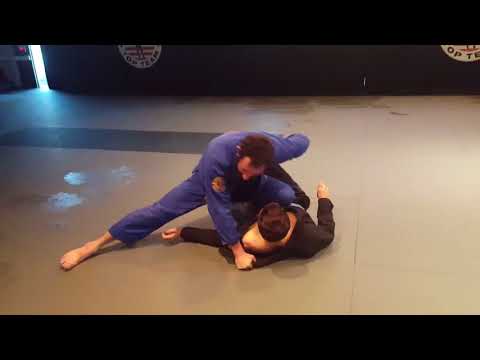
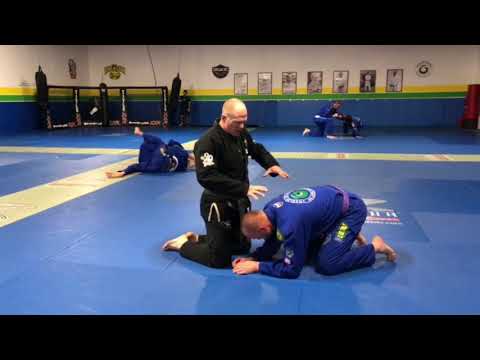
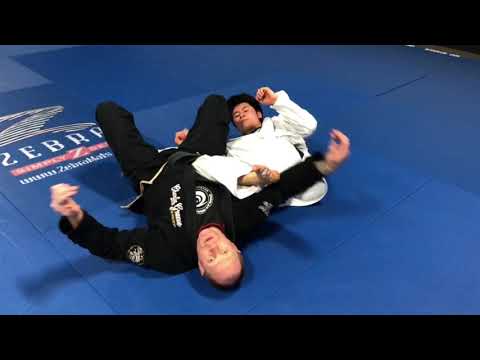
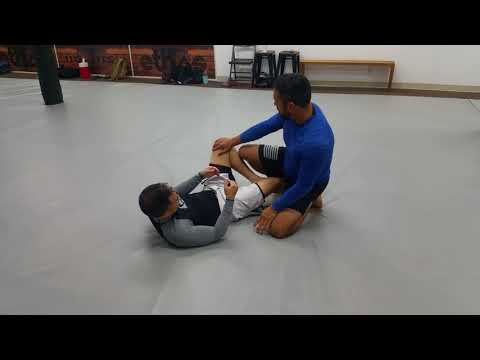
A De La Riva Pass to the negative side named the Russian because of the way you bend and kick out the bottom leg to break the hook and kill it while also bouncing off of it to take knee on belly.
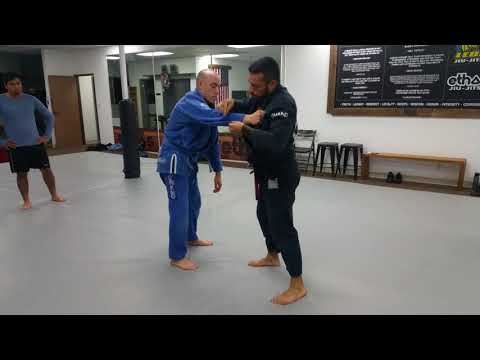
Professor Charlie Liu is the co-founder of Digitsu and a long time BJJ practitioner. He talks about self defense, small joint manipulation, asking questions in class, starting Digitsu and filming disaster stories.
This episode is just a little different! Today 12 BJJ black belts give their single best piece of advice for people just starting out in Brazilian jiu-jitsu. White belts looking for tips and help with their training will really benefit from watching this, and if it doesn't fire you up and get you on the mat grappling then nothing will!
Here are the BJJ black belts featured in this video:
Stephan Kesting http://www.grapplearts.com
Bernardo Faria https://bernardofaria.com
Brandon 'Wolverine' Mullins http://www.justgipants.com
Travis Stevens http://www.fujisports.com/blog/travis-stevens/
Rob Biernacki http://www.islandtopteam.com/
Pshemek Drabczynski http://www.besthometrainer.com
Ritchie Yip http://www.infighting.ca
Sean McHugh https://www.alliancekelowna.com
Elliott Bayev http://www.openmat.ca
Jason Manly http://instagram.com/jasonmanly
Michael Zenga http://www.bjjfanatics.com
Perry Bateson http://www.nwjja.ca/
Also you can download my (Stephan's) checklist of BJJ positions and techniques for free at http://www.grapplearts.com/book
See you on the mat!
In this short episode I share a tip I learned from Elliott Bayev that'll simultaneously allow you to finish way more people with your chokes but also stop you from completely burning out your arms, legs and/or grips in the attempt.
If you're looking for help with a specific area of grappling have you checked out the search bar at the top of my site http://www.grapplearts.com? Tons of videos, tips, articles, and drills there just waiting for you to find them!!
Dan was bitten by the MMA bug after watching UFC 4; soon he was training with Dan Severn and learning all he could about wrestling, jiu-jitsu, fighting and MMA. Many miles and multiple black belts later he's on the podcast.
In this conversation we focus on the fighting aspects of jiu-jitsu, 'friendly' sparring sessions gone bad, catch wrestling, Systema (yes, systema), training with hundreds of MMA fighters, doing MMA color commentary, and the lessons learned from decades of living the fighter's lifestyle!
Dan's website is https://thecombatsystem.com and he currently teaches at http://charlestonfitmma.com
OK, so you've just learned a cool new technique that you're pretty sure is the Kryptonite you need to defeat your hardest sparring partner. But then you crash and burn when you try it out in sparring - he ignores your move, passes your guard, smashes you flat and taps you out. What's going on? In this episode I break down exactly why techniques NEVER work on the day they're shown, and the simple steps you need to make that killer technique functional as fast as humanly possible.
Check out my FREE app for learning BJJ, The Roadmap for BJJ app for iOS and Android! More information at http://www.grapplearts.com/roadmap. It's my most popular instructional app, so it must be helping someone!!
Loved this interview with Reilly Bodycomb. Reilly is a Russian sambo and leglock expert who has competed in a TON of different rulesets including BJJ, no gi submission grappling, MMA, Sambo, and wrestling. He shared stories about competing all over the world, and shared some major insights about how the rules you compete under totally influence the development of a sport. My favourite part was when we were riffing about creating the 'perfect' grappling rule set. I hope you enjoy it as much as I did.
If you enjoyed it then please share this podcast episode with at least one friend or training partner - that's how this podcast grows and I really appreciate it!!
Find out more about Reilly Bodycomb and his upcoming ankle lock instructional at https://www.rdojo.com
Cheers!
Stephan
This is a fun episode: instead of me doing the interviewing the tables get turned and I get grilled by Cody from the Codyjitsu podcast. We covered tons of stuff including my martial arts background, how I got my black belt, my favourite moves and techniques, specific strategies to train around injuries, the role of competition in training, and much more.
Follow Cody on Instagram: @AmericanGrapplingAcademy
Follow me on Instagram: @Stephan_Kesting
And if you've actually read down this far then why not go and give The Strenuous Life Podcast a rating or review on whatever platform you listen to it on.
That kind of stuff is super appreciated, and it's really helping!
One of the very worst things is to be trapped on the bottom with all your opponent's weight on top of you and be unable to breathe. This is usually followed by exhaustion, panic and surrender.
But it doesn't need to be like this – there are several approaches to breathing in BJJ that can make sure air gets into your lungs, oxygen into your blood, and keep you in the game, even when you're being completely crushed on the bottom.
The following video breaks down the 3 levels of answers to this problem.
- Physical conditioning - Psychological adjustments - Technical answers
## Better BJJ Breathing Part 1 – Physical Conditioning Some people think that if they just had better cardio or stronger abs that they would have an easier time breathing when there's a big giant guy lying on their chest.
And they're right… sort of, kind of…
Yes, better abs and cardio will definitely help. So do more crunches, leg lifts, running, swimming and elliptical trainer work.
In fact some systems of Karate like Kyokushin go so far as to bounce up and down on each other's stomachs with a heel firmly planted on the diaphragm to teach learning breathing while maintaining a very tight core.
## Better BJJ Breathing Part 2 – Psychological Adjustments Many people simply stop breathing when they're in stressful situations.
This can be a byproduct of suffering from claustrophobia, or it can be a standalone problem.
I have addressed both of these issues in previous blog posts, and the feedback that I have received tells me that a LOT of people have found them VERY useful. So if you even think that this could be part of the problem for you then I strongly suggest that you skim these two articles and figure out if they contain the solution to your problem…
ARTICLE ONE: Dealing with Claustrophobia in Brazilian Jiu-Jitsu
and
ARTICLE TWO: Breathing, Oxygen and Exhaustion
Check them out.
## Better BJJ Breathing Part 3 – Technical Answers If you're in reasonable shape, don't think that you're holding your breath, and don't suffer from claustrophobia then there are probably technical answers that'll fix your breathing in bad positions.
I cover these in considerable detail in the video above (or, if you prefer, here's the same video about breathing on the bottom on Youtube) so I would watch that.
The main themes are…
**Breathe Easier by Getting Onto Your Side**
It's really, really tough to breathe well in BJJ when you're flat on your back and your opponent has his weight on your diaphragm (the large muscle that separates your lungs from your guts that is roughly at the level of your solar plex).
If you're flat, and he has weight on your diaphragm, you're going to suffer. It's that simple.
If you're on your side, with one hip and one side of your body off the ground, then breathing is much, much easier.
Sometimes this is as simple as planting both feet, giving a little bridge, then turning onto your side with a shrimping motion.
There are some other tricks as well. For example, in the video version of this podcast (https://www.youtube.com/watch?v=Vf07y7rmsxE) above I shared something I learned from Carlos Machado which he calls 'power hips.' In this manoeuvre he plants one foot and then extends the other leg far out to the side.
This power hips position naturally lifts one hip off the ground and turns the body onto the side.
When you do it under an opponent, regardless of what top position he's in, it makes breathing much easier. He also has an entire escape system based on power hips that I've been playing with but haven't come anywhere near to mastering yet!
**Breathe Easier by Opening Your Mouth WIDE**
Here's a breathing trick I learned from Walter Lanz, one of my old Judo instructors…
If you're getting smothered under your opponent's gi then resist the temptation to close your mouth and instead try opening your mouth as wide as possible.
Do this experiment with a gi in private so that nobody will think you're crazy…
Hold a gi over your face and try breathing through it with tightly pursed lips. Really difficult with a small breathing hold, right?
But when you open your mouth all the way then you've got much more surface area of gi to pull that air through. It might not be easy, but it's a lot less difficult
Wider mouth usually means more oxygen in a smother situation. It's not a 100% solution, but then nothing is; that is why BJJ is a martial art and not a martial science!
**Breathe Easier by Not Exhaling Fully**
This one is really counterintuitive.
Most of the time I advocate breathing deeply, breathing fully, and not limiting the amount of oxygen you're taking in when you're working hard.
But if there's a lot of weight on your chest or diaphragm you actually DON'T want to exhale fully for the time being. That's because once you've breathed fully out your lungs will be contracted, and then the weight of your opponent will make it impossible to fill your lungs fully again.
So you actually want to breathe rather shallowly. Keep them as full as possible until you manage to get one hip off the ground and get onto your side (like we discussed a little higher in this article).
## Stay Breathing my Frens! There, I hope this overview of the physical, psychological and technical factors allowing you to breath effectively in BJJ (or any grappling sport really) when there's a ton of weight on you is helpful.
Sometimes you can make huge strides with tiny adjustments, and I think this is one of those areas in which it happens.
I've known at least two pro MMA fighters who used to *freak out*whenever they were on the bottom. They were claustrophobic and couldn't breathe as soon as anyone got on top of them.
But by learning to deal with the claustrophobia through progressive desensitisation, making subtle adjustments to their position on the bottom, and developing excellent escape techniques they overcame those problems and went on to have relatively successful MMA careers.
So it can be done!
Take heart, figure it out, keep training!
Stephan
**P.S.**If you found this useful please consider signing up for my free BJJ email newsletter.
It's full of tips just like this one on techniques, training methods, and tricks you can use to get better fast. And I'll also send you a free copy of my guide to learning BJJ fast called 'A Roadmap for BJJ.'
Like I said, it's completely free and very easy to opt out of if you don't like what you're getting.
Go to http://www.grapplearts.com/newsletter to sign up for free!
I really enjoyed talking to Lieutenant Kevin Dillon (ret) who served for 25 years as a police officer, SWAT team member, and detective commander before moving on to become a full time trainer for police departments.
In this episode we talk about his closest calls on the street, how police departments train their officers to fight, degrees of force and escalation in combatives, how to talk somebody down, strategies and tactics that anyone can employ to keep themselves safe, and much more.
Regardless of whether you're a LEO (law enforcement officer) or a civilian I think you'll find this useful!
You can find out more about Kevin at PoliceCombat.com
Getting tired when you're rolling sucks. And it's even worse when you're competing; you can't breathe, you go into survival mode, your plans goes out the window and life starts sucking.
In this episode I share my number one tip for beating this exhaustion and performing up to your potential in competition.
Let me know what you think of these tips and mini-rant podcast episodes. You can find me at the following places...
Twitter: http://www.twitter.com/stephankesting
Instagram: http://www.instagram.com/stephan_kesting
Snapchat: I'm 'stephankesting' or click here: Stephan on Snapchat
Facebook: http://www.facebook.com/grapplearts
Thanks!
Stephan
Matt Kaplan joins the show for a hilarious and entertaining episode! Topics include pro wrestling death matches, pro wrestling moves in MMA, leg locks, punk rock and rolling drunk. He also talks about training with Garry Tonon and Eddie Cummings.
To get better fast in any sport you have to be able to train hard, which means minimising injuries and maximising your recovery. In this episode I give you some of my best tips to accomplish both of these goals. If you found this information useful then please share the podcast with ONE other person who might also benefit from hearing it.
Thank you so much ,
Stephan Kesting
[www.grapplearts.com](http://www.grapplearts.com)
www.selfdefensetutorials.com
In this rant I go off about so-called 'technique collectors', which are martial artists who memorise 35 different variations of a technique but are unable to execute ANY of those variations against a real opponent giving even a little bit of resistance. Then I go through the 5 step formula for taking any technique and making it functional. This 5 step formula is broken down for you in more detail on my second website http://www.selfdefensetutorials.com/makeitwork. Hope you find this rant informative, or at least entertaining!
Justin "Master Chim" Garcia makes his second appearance on the show for a deep discussion of self defense, dealing with armed attackers from a grappling standpoint and building muscle memory. He also talks about the direction of competitive grappling.