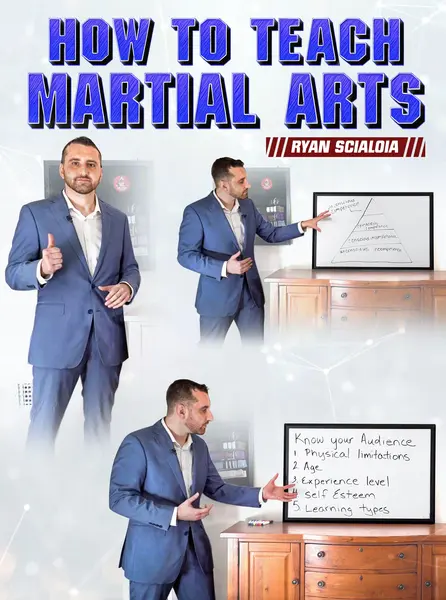
Impact Lives on A Greater Scale Through The Power of Martial Arts and Master The Key Elements of What It Takes to Become a Phenomenal Teacher - INCLUDES E-BOOK
<!-- split -->
Check out a free sample:
So, What Exactly Do You Get?
PART 1
INTSTRUCTORS TOOLBOX
PART 2
HOW TO STRUCTURE YOUR CLASSES
PART 3
STUDENT DEVELOPMENT
PART 4
NOBEL PRIZE WINNING METHODS OF LEARNING
PART 5
COMMUNICATION
PART 6
PREPARE YOUR STUDENTS FOR COMPETITION
PART 7
CHARACTER DEVELOPMENT/MARTIAL ARTS AS A VEHICLE FOR SELF IMPROVEMENT
$77
Course content · 7 volumes · 79 chapters
1
Volume 1
- 1. Instructors ToolBox - Intro
- 2. Table Of Contents
- 3. Instructors Tool box section: Pre-framing
- 4. Re-framing
- 5. Know your audience
- 6. Focus anchors
- 7. Beginning strong
- 8. The Last Impression is the lasting impression
- 9. Praise In public, reprimand in private
- 10. Keep safety as the #1 priority
- 11. Be mindful in how you correct your students
- 12. Praise, correct, praise
- 13. Tell stories
- 14. Make the material simple to understand
- 15. Remember your students names (and use them often)
- 16. Admit when you don’t know an answer
- 17. Use metaphors
- 18. Make the lesson fun and playful
- 19. Teach with passion and enthusiasm
- 20. Be mindful of their attention span
- 21. Disguising repetition
- 22. Making the most of every moment in class: (No down time)
- 23. Explain the move/procedure with the inflection you'd like it performed
- 24. Training Your Assistant Instructors
2
Volume 2
- 1. How to Structure Your Classes - Write out a lesson plan with room to deviate
- 2. Structuring lesson plans 1
- 3. Structuring lesson plans 2
- 4. Structuring lesson plans 3
- 5. Structuring lesson plans 4
- 6. Central problem theory
- 7. Building upon a sense of advantage
- 8. Fitting your classes into this framework
- 9. The process in which you show a move
3
Volume 3
- 1. Student Development - Who what when where why and how
- 2. Identify how your students best learn (kinesthetically, auditory, visual)
- 3. Mastering how to learn will show you how to teach
- 4. Using language as a Super power
- 5. Explain clearly what your students can expect of you
- 6. Explain clearly what you expect of your students
- 7. Drilling
- 8. Knowing and understanding the difficulty of group instruction
- 9. Everything we do in teaching must be done with love if not it will fail - Sensei Marti
- 10. Meet their needs and know their goals
- 11. Progress checks
4
Volume 4
- 1. Nobel Prize Winning Methods of Learning - The Dunning Kruger effect
- 2. The 4 steps of learning conscious competence, un conscious competence etc.
5
Volume 5
- 1. Communication Skills - Tonality
- 2. Physiology
- 3. Matching and mirroring
- 4. Too much or too little eye contact
- 5. Too much or To little Interpersonal Space
- 6. Poor Hygiene
- 7. Lack of Filter
- 8. Too much or too little self disclosure
- 9. Gracefully entering/leaving an interaction
- 10. Using backchannel cue’s
- 11. Accepting compliments graciously
6
Volume 6
- 1. Prepare your Students for Competition - The parable of the plank
- 2. Old trainers trick
- 3. Learn the rules of the competition
- 4. Running camps
- 5. Try to simulate
- 6. Tell stories about your experience
- 7. Developing a strategy with your students
- 8. The 3 archetypes of martial arts endurance
- 9. Recording/breaking down their match footage
7
Volume 7
- 1. Character Development/Martial arts as a Vehicle for Self Improvement - Make every character development session a masterpiece
- 2. Teaching kids
- 3. Perseverance example
- 4. Good thinking/stinky thinking
- 5. Honesty example
- 6. Discipline means
- 7. Courtesy means
- 8. Miyamoto Musashi Quote #1
- 9. Distance management
- 10. BJJ and life are a game of what you are willing to accept
- 11. "If you think you can or if you think you can’t you're right” - Henry Ford
- 12. Self defense
- 13. Socrates quote
Linked to
More Instructionals
View all
$79.00